Sunday, August 24, 2014

The Scales report

My opinion piece 'Lessons from the latest NBN reviews' appeared in Tuesday's AFR commenting on the Scales and KordaMentha governance reviews.

It is by no means everything I would like to say about those reviews - but space did not allow more. This is a more extensive and updated commentary on Scales (but does not repeat everything from the original).

The Scales report released by the Minister for Communications, Malcolm Turnbull, into the public policy process from April 2008 to May 2010 is of little more than historical interest to the community.


Despite the access Bill Scales had to individual and documents, the report provides virtually no new information on the development of Broadband policy. The reverse is sometimes the case, that Scales passes over or fails to consider significant issues.

Most importantly it found absolutely no evidence that there had been at any point a public announcement that was different to the private advice. This is most significant given the way Mr Turnbull continued to assert that there was some mischief in the policy process. 

For example, in answer to a question without notice on 20 November 2013 he tried to connect the calculation by Lazard's of a negative $31 billion NPV with the Corporate Plan detail of a 7% IRR saying "No wonder Australians lost faith in Labor. No wonder they are sick of their spin." 

Later on 11 December he finished an answer with "Tomorrow we will see the truth about the NBN. The Labor Party do not want to hear it. They do not want to know how many billions of dollars they have wasted. They do not want to know how many falsehoods they have told." None of the reviews conducted by Mr Turnbull has found any evidence of falsehoods.

However, its political and public policy purposes and conclusions should be noted by all because they will continue to be the core themes of policy over the next few years..

There are three important observations to make. The first is that all policy is bounded by the current reality, optimal solutions are constrained by sub-optimal starting points. The second is that the public service has been so gutted from 1996 on that it is unable to perform its essential roles. The third is that because public policy is determined by a political process, all statements are political.

The current Minister has regularly made much of the limitation he faces in implementing his NBN policy by the current state of NBN Co. The same was true of Senator Conroy as Minister who inherited two decades of policy failure. This started with the policy to pursue infrastructure based competition that so spectacularly failed in fixed line markets. It was compounded by the privatisation of Telstra.

The facts at the time Labor announced its 2007 policy was that Telstra had made a totally unacceptable policy proposal to Howard Government, and that Government had struggled to respond. In his report Scales claims “During 2007 the Howard Coalition Government was actively attempting to speed up the roll out of broadband in Australia.”  A core element of the “Australia Connected” package announced in June 2007 is stated as:

A plan to facilitate a new commercial fibre optic network build in cities and larger regional centres via a competitive bids process and subsequent enabling legislation. This process was to leverage the previously announced proposals to roll out a commercial fibre broadband network by Telstra and the G9 consortium (neither organisation was seeking funding). The aim of the competitive bids process was to evaluate the regulatory arrangements for the investment in an open and transparent manner. (P.16)

This was, in effect, a tender for regulatory arrangements. Telstra was seeking exemptions from aspects of the access regime while G9 required access to Telstra’s copper. The Departmental process for this exercise was the precursor to the NBN Mark I - with an Expert Panel chaired by the Secretary of the Department.

The final main component of the environment Senator Conroy inherited was a Telstra management team that had declared outright war on the Government. Bill Scales had his own disagreements with Donald McGauchie, the Telstra Chair who led the robust changes. The Chair’s insistence in hiring John Short to assist with the final privatisation was claimed to be the reason for Scales resignation.

That the conditions for policy implementation are far from ideal puts additional pressure on the public service. The Scales report, and indeed the National Audit Office review of NBN Mark I, found the public service at least missing in action in the outcomes. Scales in his report concludes:

It is clear to me that during the whole of the period of this Audit, public officials involved in the NBN policy development process, in both its manifestations, worked with remarkable dedication and commitment to attempt to make this policy work….

However, it is also clear from the evidence provided to this review and from the comments from those I interviewed from within the public service that they had difficulty in having their ‘voice’ heard on many of the most important public policy matters related to the Labor Government’s NBN policy.

Scales notes that in part this can be attributed to the chaotic processes of the Rudd Government. He is generous and attributes it to the specific circumstances of the early Global Financial Crisis period, but as history shows there was a serious issue with the management approach of the Prime Minister himself. The recommendation that the Australian Public Service examine its capability and impact is certainly worth adopting.

As I will explain later I think Scales is over-describing the supposed impact of the chaos and the impact in Government on the project. However, there are a number of very specific areas where the public service was deficient in executing the Labor 2007 policy. Two principal ones were the choice of a standard tender process and a lack of appreciation by Department officers of the centrality of industry structure reform to the Government.

The ANAO report on the NBN tender referred approvingly of the processes pursued by the Department to maximise competitive tension. This is usually a good thing, because it brings the price to Government down. But it was entirely the wrong outcome for the NBN. The two major expected respondents, Telstra and the G9, meant that the loser of the tender was going to become a customer of the winner.

While Telstra had, in the words of Phil Burgess, rejected the idea of holding hands and singing Kumbaya, the idea of a single approach with all RSPs participating was actually the best outcome for Government.

The evaluation criteria for the tender included the degree to which the response resulted in industry structural separation, but it was only one and none of these had been weighted. When the Regional Telecommunications Independent Review Committee chaired by Bill Glasson proposed to include in its recommendations an absolute requirement for structural separation under the NBN, Departmental officers expressed concern. On their reading this was not an absolute requirement. The Minister’s office had no such concern.

As the Mark I tender came to a conclusion this became the defining issue for Telstra. It was the Government’s refusal to undertake not to seek structural separation that resulted in Telstra not submitting its full bid. (It is also worth noting that Scales concludes the exclusion of Telstra was entirely appropriate). Telstra could only be taking this position so late in the process because the centrality of the issue was not clear in the tender.

Senator Conroy has made no secret of the frustration he found with the Department Secretary he inherited and her reappointment. He has always been clear that structural separation was a core element of the policy, and has been clear that a simple purchasing tender process was always the wrong approach.

I do know that when the Secretary was writing the strategic imperatives for the Department she had implementing the Government’s policy as the primary objective. As I was briefly in the Department at the time, I suggested that the actual first priority was to advise the Minister on the economic, social and technological changes occurring that might require a policy response. The Secretary rejected that.

The position of the Department Secretary reflected two changes that had occurred under the Howard Government. The first was the unequivocal position that policy would be made by Ministers and communicated to the Public Service for implementation. The second was that expert advice was no longer provided by the bureaucracy but outsourced.

So to the extent the Public Service failed in the implementation of the NBN policy it was primarily a consequence of Howard Government reforms.

On this subject there is clearly much progress to be made. The Government also released last week a perfunctory response to the Interim Report of the Senate Select Committee on the NBN. In a number of places it states that a more detailed view of the issues arising can be found in a document (Response to the Senate Select Committee) which was posted on the Minister’s blog. The metadata of that document reveals it was authored by a member of the Minister’s staff.

Finally, the Scales Review provides deep insights into how public policy is always inherently political.

The first evidence is in the management of the report itself which has been released in a way designed to maximise the reporting of a simple message. It was tabled out of session in the Senate and posted on the APH website just before 5pm. Journalists from The Australian were asking questions of Opposition members as early as 5:15pm (or as late, given deadlines). Only The Australian and Communications Day seemed to be aware of it. The Australian predictably splashed the story under the headline “Labor’s NBN ‘rushed, chaotic’." Yet the fact is that Scales didn't say the NBn process was rushed and chaotic, he said that Government as a whole rushed and chaotic at the time the report was considered.

Minister Turnbull then ran with his rehearsed lines about Labor’s NBN being a most wasteful exercise. However, Minister Turnbull did not reflect on the substance of the Scales report, in particular recommendations that all projects over $1 billion be subject to cost benefit analysis by the Productivity Commission or Infrastructure Australia. That is perhaps because Mr Turnbull eschewed these august bodies for his own CBA, and secondly because his CBA is two months overdue.

****

My published comments noted:

Reports also focused on the criticism of the ACCC’s advice on the cost of FTTP versus the cost of FTTN followed by an upgrade. The two Professors on the Expert Panel are, however, have previously stated that it was a conclusion reached independently of the ACCC advice.

In fact it is far worse than this. Professor Tucker this week came out to record that Scales was wrong on his assertions about the ACCC advice writing:

He also argues the panel of experts (of which I was a member) assisting the Rudd government did not properly test advice from the Australian Competition and Consumer Commission (ACCC) about the upgradeability of a Fibre-to-the-Node (FTTN) network to a Fibre-to-the-Premises (FTTP) network, and that the panel inappropriately relied heavily on this advice in making recommendations to the government about the development of the NBN.

Professor Coutts made his in a letter to Communications Day so I will repeat them here:

Re ‘Rod Tucker claims Scales ignored advice on ACCC role’ in yesterday’s CommsDay. As a member of the expert panel with Rod Tucker on the 2008/09 version of the NBN formulation I can only strongly echo Rod’s comments that we thoroughly considered the options for the NBN particularly FTTN and the possible scenarios to transition to a FTTP solution which is accepted worldwide as the ‘final solution’ as [Telstra chief scientist] Dr Hugh Bradlow has said publicly several times! Our conclusion in 2008 that FTTN could not be assumed as a transition to FTTP (unless done by Telstra!) was reached before the ‘unsolicited’ report by the ACCC was received literally at the 11th hour of the process and certainly did not influence our conclusion. Mr Scales mentions only one (Analysis-Mason) of three detailed reports comparing the costs of FTTP versus FTTN which we considered, all of which are in the public domain!
Rod, I and Tony Shaw each individually told Bill Scales that the ACCC ‘bombshell’ as it has been termed was NOT a major influence (let alone a ‘bombshell)’ on our conclusion re FTTN transition to FTTP. Tony Mitchell who was unable to meet Mr Scales also shares this recollection. I cannot usefully speculate on what John Wiley and Patricia Scott would recall as influencing their decision to concur with the conclusion made by the panel. Hopefully the history of NBN will be written from objective analysis of the evidence (both written and oral) and after reflection of outcomes for Australia!

Kim Williams demonstrates bias for prejudice over facts

The SMH published an extraordinary extract from Kim Wiliams' new book Rueles of Engagement yesterday. Headed NBN wars we are told that 'Former Foxtel and News Corp chief executive's new book explores the dysfunctional regulatory regime that set the stage for the government's costly NBN rollout.'

The extract is so riddled with errors I am reproducing it in full here with my commentary. The original text is in bold - my commentary in italics.

In periods of technology evolution it is profoundly dangerous for governments to act as a proxy for normal commercial processes. Anointing winners never works. That is not and should never be the game of government.

"Normal commercial processes" in fact do not apply to the construction of infrastructure with natural monopoly characteristics. Government is forever picking "winners" - be that for tenders for road construction or even in making the decision which road to build. The NBN policy consisted of both - an attempt by tender then a decision to self construct.

The National Broadband Network (NBN) is the most recent example of an unaccountable announcement with a humungous financial commitment being made by a government with limited real understanding of its actions, based on poorly developed strategy and nothing more than technology romance. The hubris contained in a commitment to provide ‘‘ fibre to the premises’ ’ (FTTP) for more than 95 per cent of Australian homes misunderstood the complexity of the technical landscape, especially with regard to the exponential innovation and growth in smart wireless technology. It would be a subject for a political sitcom.

The Government's initial policy decision announced in April 2009 was informed by a range of Government agencies and the outcome of the original tender. That is on the record and backed up by the Scales Review. The final decision - the one on which funding was made - flowed from the Implementation Study and the first Corporate Plan. The decision was very well informed.

Evidence of the role of the Implementation Study and other research flows in the move from a 98% FTTN originally proposed, to a 90% FTTP goal and then a 93% FTTP objective in the Statement of Expectations informed by the Implementation Study and the Corporate Plan. In fact, understanding the "complexity of the technical landscape" is why there has NEVER been a goal to connect "more than 95 per cent" with FTTP.

No-one in the tech community is still backing "smart wireless technology" as an alternative to deeper fibre penetration. 

I followed the NBN with keen interest because it was core to the future of media and telecommunications and fundamental to any number of future commercial decisions. At Foxtel we embraced a constructive approach, given the then government’s almost virulent dislike for any public or private criticism, and so we assumed it would be happening and we had better live with it and ensure the best outcomes we could. In a speech to the National Press Club I think I used the euphemism ‘‘ bold’ ’ or ‘‘ courageous’’ .

Is it indicative of Williams that when he follows something with "keen interest" that he gets the detail of the policy wrong?  I do admit that I could never understand News Ltd's opposition to the NBN. While it potentially gave a serious leg-up to OTT competitors, it also offered News the ability to break out of its very unhappy symbiotic relationship with Telstra. 

Williams in his Press Club address used "bold". One might think he could have looked it up on the Foxtel website himself rather than rely on his memory. That speech - of course - was just the usual very insular diatribe of the Foxtel wish list. Nothing at all really about visions of the digital economy, just a narrow insular position of what served the interests of Foxtel. 

The original decision by Kevin Rudd and Stephen Conroy reflected an unusual degree of ignorance as to how the broadband challenges in Australia had come about from poor regulatory settings and the absence of well-developed long-term policy. The complex set of circumstances as to what was driving this craziness seemed to be well understood in the telecommunications markets but was badly managed on both sides of politics and abominably by the bureaucrats who were commercially naive and inexperienced. The result is that a cost well beyond $40 billion has been foisted on the taxpayer with uncertain return let alone secure capital recovery.

The simple fact is there were two contending views of the "complex set of circumstances" that were creating the broadband challenge. Telstra's view was that it had no incentive to invest in an environment of cost-based regulation, its competitors view was that Telstra had the incentive and opportunity to favour itself through being vertically integrated. 

Both challenges were attempted to be addressed through the NBN Mark I tender, through the contribution of Government capital to ease the investment hurdle, and the requirement for a separated open-access network. I will agree that the use a standard procurement process tender resulted in a poorly managed outcome, but the ANAO does not share that criticism. 

As has been outlined in the first interim report of the SSCNBN the so-called "Radical Redesign" scenario in the NBN Co Strategic Review is the more accurate description of what the Board and management of NBN Co were forecasting in September 2013. It still however understates revenue and overstated potential completion times. That scenario does not support the contention of "uncertain return let alone secure capital recovery."

The NBN could easily have been established with existing and new private sector telecommunications players using their own capital, provided the ground rules as to operational objectives had been clearly spelled out and the regulatory settings and expectations were clear and sufficiently certain that the necessary long-term capital could be deployed confidently . This would have confined the cost to the taxpayer to several billion dollars to meet evident areas of disadvantage (economically or geographically).

This was simply not the case because the player with access to the network refused to bid on the basis that structural separation was not something they were prepared to agree to. 

The reason that this sad, confused disarray has come about lies equally at the doors of the Australian Competition and Consumer Commission (ACCC) and a neophyte government possessed with the view that it could solve the issue with a single silverbullet solution.

There was a public policy process that ran for almost two years from the April 2009 announcement, and it was a revision of a previous policy approach. This was neither rushed nor determined by the activity of a single agency.

The decision was made in an air force jet between Kevin Rudd and Stephen Conroy with no financial or other constraints; the worst kind of politics: fast-fired , remote decision making with no professional or grounded advice as to how it might work and how it would be defended convincingly over a very extended timeframe.

The extent to which any "decision" was taken on a VIP flight in January 2009 it was simply that the Minister could bring forward an alternative proposal to NBN Mark I to Cabinet. Everyone should read the Cabinet Manual - that is how everything starts. Development of a policy to bring to Cabinet requires the approval of the PM first. 

In fact as Wayne Swan's book has now revealed there WAS a proposal to rush the analysis and include it in the stage 2 stimulus announcement in February. But it wasn't - it was subject to detailed review by central agencies and the SPBC (or gang of four).

Telecommunications in Australia has been bedevilled by a dysfunctional regulatory regime ever since the OTC/ Telstra merger and then when the Telstra monopoly was broken and subsequently privatised. The ACCC, due to its serial under-performance in the telecommunications arena, is largely to blame. It has a well-developed ideological detestation of Telstra on the one hand and has enabled itself to be gamed ruthlessly by Telstra’s competitors on the other.

The ACCC has no "ideological detestation" of Telstra, no matter how much it might feel like that to Telstra. At the point Williams is referring to ACCC decisions were subject to merits review by the Australian Competition Tribunal and I am unaware of any case where the Tribunal found against the ACCC. 

"Gaming" was a conduct involved in by both sides, as ultimately it should be if firms are seeking optimal outcomes for themselves. That the system itself suffered from serious design flaws that permitted gaming there is no doubt.

What it has never achieved is a clear set of operating rules to achieve a constantly improving competitive landscape that encourages competition and innovative evolution to consistently improve consumer outcomes. The commission seems never to have accepted that when competition works well it can be ferocious – there are winners and losers.. All too often the commission endeavours to correct the market for those who fail in order to shape and drive it, aiming to shape the market in an image that suits its own preferences. The ACCC has not been held to account by successive governments and, in fairness , parliaments for the entirely dysfunctional telecommunications landscape and the resultant costs that have been passed over to the longsuffering taxpayer.

No doubt, from time to time Telstra has massively overplayed its hand and the competitive respondents have resorted to invoking excessive recourse to the ‘‘ mother regulator’ ’ in response. What has resulted is a largely toxic regime between the ACCC and Telstra from the late 1990s through the first decade of the 21st century.

The ACCC was never making "winner vs loser" decisions nor exercising subjective judgement. It implemented the law, as is its job. 

David Thodey’s regime as CEO of Telstra in recent years has convincingly addressed much, but the negotiated outcome in that period to secure the NBN has become the new reality: it replaces a private, near-monopoly network with a new government-owned and controlled monopoly, which hardly constitutes major progress on any reasoned analysis.

Let's just be clear that the operation of Telstra as a private near-monopoly is a creation of the 1990s. The model of Government building and owning telecommunications infrastructure has been the global norm - other than in North America. That original monopoly HAD repaid all is capital and provide a return on investment each year prior to privatisation - an asset with a carrying value of zero was then sold for tens of billion of dollars.

The only time anything like infrastructure based competition had threatened it was in HFC networks, and Foxtel was the beneficiary of the decision by Telstra to build its own. Just so that the former CEO of Foxtel gets it - the HFC network which was Foxtel's only original distribution medium was built by Telstra when it was entirely Government owned.

And also, so he gets it, there is a huge difference between a vertically integrated firm that competes in retail markets with its wholesale customers and a wholesale only open access network.

Conroy was obsessed that the provision of enhanced broadband would be centred around an FTTP approach across the length and breadth of Australia . This was built on the vainglorious empty statement he repeated endlessly to anyone who would listen: ‘‘ nothing is as fast as the speed of light’’ . This approach had little to do with the reality of hybrid technology environments and the complexity of modern technology options and networks, let alone diverse user needs and affordable costs. The leaden hand of government in mandating that the solution had to be fibre and a new monopoly demonstrates the poor intellectual investment in the whole process.

I don't recall Senator Conroy using the line "nothing is as fast as the speed of light" much - though it has been used by many, including the head of New Zealand's Crown Fibre Holdings.  As I've previously written it is also dumb, because the propagation speed of light in a silica fibre is slower than either radio waves or current in a twisted pair. 

The fact that Kim Williams hadn't read it does not mean that there had been no extensive analysis. Some was in the public domain. Also as I wrote for the AFR an analysis of FTTN post NBN Mark I was pointless as Government had no access to copper, and also as I wrote for the AFR (different story) to get Telstra to take Government seriously they had to commit to a network that did not need Telstra. 

There was no publicly available strategy supported by an independent needs audit or future options backed up with an independent cost/benefit analysis. For the government to usurp an arena where the private sector has the capital capacity and experience, reject existing players and accept the financial and rollout responsibility in the largest single start-up in world history should demand an explanation and clear reasoning and accountability for the decision.

The Government did not "reject existing players", existing players rejected the Government. As to private sector "capacity and experience" to build the network, NBN Co used exactly the same outsourced contractors that Telstra has used over the years - including one, Visionstream, that began its life inside Telstra as the special purpose vehicle to build the HFC network for Foxtel.

The NBN in its creation, its commitment , its settings and its performance is a wholesale testament to policy and regulatory failure. If private sector undertaking was done in this fashion it would never secure finance and the board and executive team of that entity would lose their positions.

This is a line that it is hard to determine whether Williams has copied from Malcolm Turnbull or Malcolm Turnbull was picking up originally from Kim Williams. However, the Strategic Review, the Scales report and the KordaMentha review of governance have ALL FAILED to find any evidence of any policy process or governance failure. Indeed, as noted above, the Strategic Review more than anything else confirmed the business plan for FTTP. Far more importantly the Strategic Review's very best effort to calculate the "real cost of Labor's NBN" fell spectacularly $20 billion short of the number that News Ltd had blazoned across the front page of the Daily Telegraph in April 2013.

Rudd/Gillard have lost office but the ACCC continues with its ideological kitbag, its unaccountable slow processes and its lack of any capacity to innovate and provide efficient regulatory solutions that provide certainty to investors and better outcomes for telecommunications consumers. I only hope that Ziggy Switkowski, the new NBN Chairman, and his new CEO, former Vodafone CEO Bill Morrow, bring their considerable operational experience to deliver a better, saner, transparent operating environment.

Let's just have one last ideological swing at the ACCC shall we? The only "ideological kitbag" the ACCC has is its prosecution of the Competition and Consumer Act and the neoclassical ideal of competitive markets. Williams extensive list of senior executive roles includes a mix of artistic bodies, public sector bodies and private sector firms. The bulk of his private sector experience, however, has been as head of two firms that were the dominant player in very concentrated industries. One of those, Foxtel, achieved the monopoly status that any evolutionary economist would identify as the standard endpoint. That firm's comfortable position will now face competition as the consequence of technological change. It is no wonder that Williams finds "competition policy" anathema.

I really don't want to read Kim Williams book, but I am now fascinated by what else he might say.

Judging however from this extract perhaps the reason he was no longer required at News Ltd was because of a tendency to conduct analysis on the basis of personal prejudice rather than facts.

Footnote: The decision by Telstra to partner with News Ltd for pay TV and create Foxtel has been described by David Thodey as the "best decision ever." (It was in the AFR - trying to find link). For the history buffs the wise people in Telstra in charge of HFC, having decided to build an HFC network and having lost Seven and Packer to OptusVision, were determined to find an overseas pay TV partner (to match the presence of Continental CableVision in OptusVision). Only two people inside Telstra made the case for News Ltd - Harvey Parker and myself. Harvey was the more influential, but I had many productive discussions with Malcolm Colless.  


Tuesday, August 19, 2014

Telstra and its NBN Renegotiation

One swallow does not make a spring


There is so little apparent progress being made on the NBN and so little information from the Telstra, NBN and Government bunkers about the renegotiation of the Definitive Agreements that the briefest of statements is subject to intense speculation.


While the really big news of Telstra’s results announcement was strong profit growth and a share buy back, one short paragraph on the NBN got all the news. That paragraph in full read:


This Commercial Framework anticipates a change in the approach taken in respect of the copper and HFC network assets, from staged decommissioning, to NBN Co owning some or all of such assets progressively as the NBN is rolled out. As the current arrangements already provide that Telstra is progressively restricted in its ability to use the copper and HFC network assets, the Commercial Framework does not contemplate any incremental value to be received by Telstra for the transfer of ownership.


Different reports claimed the Commercial Framework used different language, one going so far as to call it  a signed non-binding heads of agreement.


The agreed Commercial Framework falls far short of a heads of agreement.


The detail that attracted attention is that it does not contemplate any incremental value to be received by Telstra for the transfer of ownership. But the same paragraph reveals the framework “anticipates” NBN Co owning “some or all of such assets.”


This indicates that the framework doesn’t go as far as even scoping the assets to be included.


Repeating a statement by David Thodey in May that continued asset ownership provided Telstra with “optionality going forward”, the results statement goes on to say “continued ownership of these assets did provide Telstra with some protection in respect of future changes in the NBN project.” It notes that Telstra is now “seeking to agree other contractual mechanisms which are designed to protect Telstra against future changes in the project.”


In brief there is potentially still a great deal of work to be done getting from the Commercial Framework to an agreement.


As outlined here in June the first lot of Telstra negotiations took two and a half years to be completed. There is no reason why the renegotiation should take so long, but the Commercial framework is still a stage before a signed Financial Heads of Agreement.


The Telstra statement included a warning that after the full financial deal is agreed, there could be additional regulatory delays, noting that “any renegotiated arrangements between Telstra, NBN Co and the Government will need to be reviewed by relevant regulators (including the ACCC) who may seek to impose further regulatory measures.”


The payment for the transfer of the assets isn’t the primary issue NBN Co needs to face. Its three cost concerns are the cost to remediate the copper network, the ongoing cost to maintain the copper and the cost to develop information systems to manage the asset it has acquired.


And everywhere “copper” is mentioned it still potentially means twisted pair copper from telephony network ad coaxial copper from the HFC network.


That said it was interesting to see The Australian report that the Minister had seized on the development since “critics” had insisted he would have to pay Telstra extra money. The first such critic, though, was Malcolm Turnbull himself in a blog post (now no longer accessible on his site - see Note) in May 2011. His comments were, however, faithfully reported by The Australian under the headline  ‘Telstra in for billions if NBN plans change’. (see Note below)


The developments in Australia stand in stark contrast to the latest development in the UK. There the use of the copper network by BT OpenReach has been the last desperate effort of an incumbent to sweat a sunk asset. But The Guardian reports “The government has raised the prospect of switching off the UK's copper telephone network, some of which is 140 years old, as it consults on the nation's future digital infrastructure needs.”


Ultimately Australians concerned about faster broadband don’t care about a lot of this detail. They either want the deal with Telstra completed so that the FTTN rollout can commence or the FTTP rollout to speed up.


Currently neither is happening.


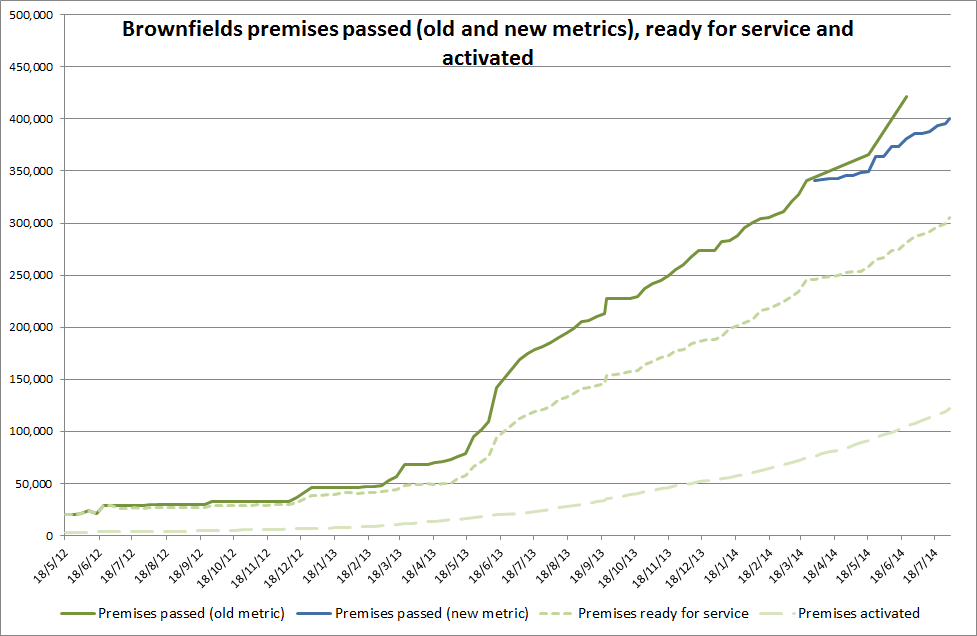
Even measuring the rate of current roll-out got harder as a consequnce of changing the metric at the end of March. At the last SSCNBN hearing NBN Co claimed the twelve week run-rate for premises passed to 30 June was 6,853. However  the run rate for premises from 4 May to 7 August was 4,015 (and only 3,871 for premises servicable.)


The chart below demonstrates there is some difficulty introduced by the change of reporting metric for premises passed. There are only two data points available for the old metric (26 May and 30 June) that were provided at Estimates and the SSCNBN respectively.


Note:

The reporting of the Telstra issue does provide a small moment of hilarity. The Australian report
started, “Communications Minister Malcolm Turnbull yesterday seized on the development, given that critics had insisted that taxpayers would have to pay Telstra extra money to get control of the copper.”

It stands in somewhat stark contrast to a story The Australian ran on 14 May 2011 under the headline ‘Telstra in for billions if NBN plans change’. That story began:
“TELSTRA could receive a multi-billion-dollar windfall if a Coalition government sought to redesign the National Broadband Network, opposition communications spokesman Malcolm Turnbull has warned.
Opening up a new front on Labor's $36 billion project, Mr Turnbull said Telstra could receive billions to make available parts of its copper network that it would have been paid to decommission under Labor's plan for super-fast broadband.”

The article was quoting a blog post from Mr Turnbull (available in web archive) saying:

“the Telstra-NBN deal will not simply deliver Telstra a $9bn windfall for decommissioning the customer access network but, in addition, set Telstra up to receive more billions when inevitably a future government -- certainly a Liberal government, and very likely a Labor government, too -- seeks to redesign the network topography in a way that reduces the crippling cost of the fibre-to-the-home design without compromising the promise of universal, very fast broadband.”

So the first politician to claim that the Telstra renegotiation would cost billions was Malcolm Turnbull himself. It is interesting that one journalist was an author of both stories.

Monday, August 18, 2014

Rundle gets the PM right

I am not normally a fan of Guy Rundle. But today in Crikey he might just have got Tony Abbott right.

Writing under the heading Tony Abbott, Australia's Most Powerful Sycophant (paywall) Rundle confesses that up until last year's election the PM presented as a complex character, that he was "a man with, it seemed, a sense of vocation coming from the Catholic Right of politics, with an idea of how politics fitted into the wider question of civilisation and of personal character."

Rundle goes through a list of latest gaffes - the effusive praise for Murdoch, the Scotland statements, the "unsettled" remark, latching onto the US in Iraq (and even asking to be asked to help) - to support his proposition that "he’s a sycophant by nature who seeks out opportunities to please those more powerful than he by being more ardent in pursuit of their interests than they ever asked him to be in the first place."

This is a better - and more complete analysis - than I'd thus far been able to achieve myself. 

All I could see was that PM Abbott was very similar to SRC President Abbott; having won the job he had no idea what he wanted to do with it. He had a list of things he was against (as PM the carbon tax and boats, as SRC Pres compulsory student unionism and funding for gays and feminists). In both cases he didn't understand that winning the election was only a step on the journey - you needed a plan after it, and some skills in managing.

The question then emerges of what motivates Tony Abbott. It is not like the position of Kevin Rudd, who also lost his way in Government. Rudd has been described as a former Minister as a "psychopath", and it fits. He was only motivated by the power of the job. This isn't the current PM.

Tony Abbott's modus operandi, according to Rundle, is "pleasing the nearest big power or audience." This explains his University behaviour in relation to Santamaria, his support of the monarchy and his relationship with John Howard.

I don't buy into Rundle's theories about the origins of this behaviour; and ultimately it is not the cause but the behaviour that affects us. It is Rundle's conclusion about political action that matters:

What matters, for those of us who would like to see the Abbott government rendered a one-term proposition, is whether it helps to predict a behaviour that Abbott himself would have less than complete control over -- and thus to create opportunities to demonstrate to the Australian people that Tony Abbott is more interested in serving higher powers, whether it be God, Crown or Mammon, than he is in simply and effectively representing the best interests of all Australians.

 
UPDATE: The original Rundle story reminded me of one of Tony Abbott's earlier comments (pre-election) on Syria (thanks to Simon Banks for digging it out for me). The SMH story began (emphasis added):

Would-be prime minister Tony Abbott has signalled that if he wins Saturday's poll, Australia will take a cautious approach to international affairs, saying that as a middle power Australia should not "be getting ideas above our station" in considering involvement with a possible US strike on Syria.
Appearing on ABC's 7.30, Mr Abbott said "we have to be very careful, because if we break something, we own it".
"I don't think we should be getting ideas above our station, " he said.
While "Australia has some heft in the world", and Australian governments of both sides had historically supported the US in military endeavours, Mr Abbott said "I just think we need to be very careful in a situation like this cause we can easily make a bad situation worse by acting precipitously. I would be very cautious about this."
"I don't think we should be getting above ourselves here. We are a significant middle power but no more."

It is not now that he thinks we are any greater a power or should be less servile, just that he thinks being more robust on the situation is what is called for. After all, despite crowing about what Australia did on the Security Council, he still thinks we shouldn't be there.


Wednesday, August 06, 2014

Data retention is not business as usual

The announcement yesterday that the Government still intends to bring forward a data retention regime is unsurprising. The stand out feature, however, remains that it is still a piece of work for the future.

It is now over four years since Ben Grubb first broke the story that Government was discussing with ISPs a data retention regime. From that point on one of the biggest questions is what is in scope and what is out of scope - with one of the key questions being exactly what was to be captured, including whether web browsing history would be retained.

Four years down the track and there is still no greater clarity. Today, trying to explain the policy, Tony Abbott got himself caught up in knots. Someone had told him the idea was really easy to explain using snail mail - the metadata is only the address written on the outside of the envelope, not the letter inside.

The first problem - as explained by iiNet in a Senate submission -  is that the dividing line is nowhere near as clear as that. Technically, as you go up each level in the ISO stack the metadata changes. At the IP level the metadata is the IP address, at the application level the metadata may be the email address or website URL.

The difficulty for the PM became worse when he went beyond the simple analogy to say on the Nine Network "''It's not what you're doing on the internet, it's the sites you're visiting, it's not the content, it's the sites that you've been." That is consistent with his analogy, because a website URL is just the address of the communication, it is where you have been. But it does mean that as far as the Prime Minister is concerned the proposal includes browsing history!

The line that has everyone confused is "My understanding is that anything generated by you is content and anything generated by the ISP is metadata." When you go browsing, you generate the URL because you type it into your computer - when you send an e-mail you create the e-mail address. Now both e-mail addresses and URL's contain domain names which at some point were "created" by ISPs - in the sense they got loaded into DNS servers.

At the core of all this is a deceptive line that is embedded in the PM's media release yesterday "The Government also intends to introduce further legislation to ... update Australia’s telecommunication interception law which predates the internet era and is increasingly ineffective." This is first and foremost a lie, because the interception regime has been updated to cover data interception. It is secondly deceptive because it carries the implication that there is data about voice services retained for law enforcement purposes and the same should happen to other data.

Way back in 1960 the PMG made a decision on automatic switching that Australia would adopt a regime known as multi-metering rather than event based charging. Under mutli-metering the PMG retaine no information about the numbers dialled.

The move to event based charging followed from the advent of SPC (stored program controlled) switching - it was not imposed by a national security or law enforcement regime. However it did create a benefit for those agencies because now Call Charge Records existed and had to be retained for charging and billing purposes. These have proved extremely useful for many investigations.

This is perhaps the point to go into the long digression about how the relevant legislation works. This has been well explained in an article by Sharon Rodrick. There are three ways various agencies can access communications information - interception of live traffic, accessing stored communications and access to telecommunications data. The first two are only available to law enforcement and national security agencies and require a warrant.

The third kind - and the area that would be expanded under a data retention regime - can be accessed by a much larger list, including "any body whose functions include administering a law which imposes a pecuniary penalty or which relates to the protection of the public revenue." The Attorney-General's Interception Act Annual Report 2012-13 shows that this latter category is a wide list. The tables below are the Commonwealth and State agencies who have accessed telecommunications data. This access is authorised by an officer of the agency, not by warrant.


The other big lie that the agencies tell the politicians and that the politicians then tell us is that the ISPs "already keep this data." By which they think they mean that the ISPs already keep it for a limited period. The origin of this appears to be a conversation between a law enforcement rep at a large telco and an agency contact that, in relation to some unidentified piece of information, "we had that information but you need to ask us to keep it."

Now, in fact, the existing regime already covers prospective telecommunications data - a telco can be required to keep data before it comes into existence - but only by warrant and only for the law enforcement and national security agencies. So, yes ASIO can access your browsing history - but only if they get a warrant and tell the ISP before you browse (like interception).

There is also a great difference between data existing and data being even accessible. For example, the details that agencies access on telephone calls come from Call Charge Records created for the purposes of billing - these are not the actual event logs generated by the switch. One telco I know received so many call detail requests it made a copy of the call record data and a query toll to facilitate response (the telco's get to charge a cost based fee - by automating they reduced the real cost but not the fee).

One classic case is simply the dynamic IP address assigned to a user during an internet session. The ISP has no need or use for this data - so it can exist only for the duration of the session in a network element, not in any queriable business system. This fact already compromises a co-operative law enforcement program - the Australian Internet Security Initiative (AISI) - which seeks to identify and rectify "bot" infested computers. A December 2012 report from the ACMA found "More than a third of the providers interviewed experienced at least some difficulties identifying computer compromises where customers had allocated dynamic IP addresses."

The allocation of IP address to user is one of the lowest levels of data that the agencies could find useful, because from that they could, for example, identify users who had visited websites they were watching (which in turn could be derived from a prospective telecommunications data warrant issued to ISPs for DNS look-ups of the relevant domain name).

It is not unusual in law for a person to be required to keep and maintain records to assist law enforcement. An example I use frequently is the requirement for traders in second hand goods to record the identity information of vendors as part of controlling property theft. The requirement on telcos to obtain identification details for pre-paid phones is another. But in those cases the extent of the imposition is well targeted at the task. (see note)

Ultimately the agencies and the Attorney-General's Department have made a complete hash of the exercise by assuming that by clicking their fingers and saying "terrorist" they will be granted new and intrusive powers. Ultimately the decision to implement the Blunn review recommendation to take the Department of Communications out of the activity has backfired badly.

There was another way to increase the amount of data retained and hence of use to agencies, which was to review retention practices for other reasons. For example, it would seem that the ACMA has a case to make for requiring ISPs to retain dynamic IP address allocation data to make AISI more effective. A direction from the Minister to the ACMA to review telco and ISP data retention policies to validate their appropriateness to guarantee the security of networks and the resolution of customer complaints would have easily justified a modicum of extension on data collection. But that was a strategy - by definition an action that takes into account the reaction of those affected by your action.

Ultimately the biggest lesson from the data retention saga is that we have learnt that the agencies we rely upon to protect us are not very strategic.


I expect more from finance journalists - Kohler and the Telstra cash

In a column today Alan Kohler speculates on what Telstra is going to do "with all that money."

He revisits the Government's NBN deal with Telstra using the Scales report as an excuse - because Scales, of course, only reported on the period before the agreement and it was out of scope.

There is nothing wrong with playing the "what should Telstra do" game - but at least it should be accurate in describing what Telstra has before it.

Kohler writes of the NBN payments to Telstra:

The $11bn is net present value. The actual money to be paid to Telstra under that agreement is closely guarded but will amount to at least $50bn. Some have put it at $100bn. Let’s call it a lot more than $11bn.

He adds, in rejecting thoughts that Thodey might decide to retire,

But I suspect spending $50bn or so transforming Australia’s largest industrial company will prove irresistible: he will stick around at least long enough to set the company’s course and entrench his legacy.

The problem with all this is that $11B is the "actual money" to be paid to Telstra (actually $13B because you need to add the value Telstra is getting directly from the Government including $450M in cash already provided). Yes it is true that in one report Goldman Sachs added the yearly payments over 35 years and got the answer $95B. But $95B today is not the same as $95B in the 35th year.

So the actual value today is the Net Present Value. Put it this way, what value of house could you buy with the set of cash flows that make up your monthly mortgage repayments? The one you have! So the asset that can be purchased by the NBN cash flows is $11B.

But the real issue is that Telstra valuation was based on what it was forgoing - in particular the forward revenue flows from line rentals - both retail and wholesale (in the form of ULL). Part of that comes in the form of the ongoing annual payments for duct rental - which is about half of that NPV. That is - it is all cashflow Telstra expected to have anyway.

The other half comes from the disconnection payments, which are made over the next six years (under the original plan) but still only amount to the bringing forward of the other half of the future revenues foregone.

The Telstra piles of cash is a complete and utter myth and finance journalists should do better than this.

Monday, July 28, 2014

On Refugees - with apologies to AA Milne

Friend Red Steel just sent me this comment on refugee policy...

Yesterday upon the sea,
I saw a not-there refugee
He was not there again today
I wish, I wish he'd go away

Wednesday, July 16, 2014

Senate to decide fate of Senate NBN Committee

A motion before the Senate today proposes replacing the existing Senate Select Coommittee on the NBN with a new Joint Committee. Those who fondly remember the scrutiny the former joint committee put on the NBN should be under no illusions that this committee will do the same.

The new Committee will be constituted with a majority of Government members (5/4). Anyone under any illusion of how the Government will use its numbers need only look to May Estimates where the Government used its numbers to limit the time available for the NBN and indeed to finish half an hour early.

The reconstituted Joint Committee also does not have analysis of the various reviews in its terms of reference. This will limit the public scrutiny of the Cost Benefit Analysis and so if it is littered with methodological flaws in the same way as the Strategic Review was these will not be scrutinised.

The disgraceful part is that the Palmer United Party Senators are supporting the change. It is well known that Mr Palmer thinks the NBN is an excessive investment of resources and the Government should only be contributing in regional areas. But that is no reason to hide what the Government is doing from scrutiny.

Let's be clear, the policy choice point is not between the NBN and No NBN, it is between building a fibre to the premises network in one stage rather than two or more. Which is the most cost effective pat his the subject of the Cost Benefit Analysis - the Strategic Review was only a costing exercise (and a poorly conducted one at that).

To hide the NBN from effective review is counter to everything Palmer claims he stands for. What did he trade Malcolm for his support at that dinner?

For the record the Minister has said some silly things about how we got to a Senate Select Committee rather than a Joint Committee and claims Jason Clare was rolled by Senator Conroy. The facts are that when Parliament resumed after the election Mr Clare proposed the Jount Committeebe reconstituted with the same structure - half each side with an independent chair (Oakshott). Turnbull insisted on a smaller committee with a majority of Government members. 

At the same time Labor had progressed a notice of motion to institute the Senate Select Committee. When Turnbull became aware of this he offered equal numbers, but still Government Chair(and casting vote). Mr Clare advised Mr Turnbull that was too late.

The best solution would be for the PUP to agree to amend the motion in the Senate, to make the numbers 5/5 of Govt vs ALP/Greens with a PUP chair.  I understand PUP has expressed no interest in the committee. This surprises me given how stridently Senator Lambie speaks out in behalf of Tasmanians. Tasmanians were systematically deceived by Mr Turnbull about his intentions for the NBN in Tasmania before the election.

If PUP are concerned about the resources required to undertake the Chair's role I can organise a pose of volunteers to help them.

And let's be clear. I am a fan of the NBN as it is. But if a properly constructed case can be made that the move to an all fibre network can be made more cheaply in two or more stages than one I am all for it.  I just don't accept arguments that 25 Meg is more than enough for an average household, or that even a 50 Meg outcome for 90% is sufficient.

Time to get active.


Monday, June 30, 2014

Announcing 'The DigEcon Gazette'

I have started a new blog with the intention of placing my digital economy and ICT policy related commentary in a separate place, it is The DigEcon Gazette.

Thursday, June 12, 2014

Joe Hockey and THAT budget

This morning's SMH reports that Joe Hockey has resorted to his three key themes in a speech selling his Budget at the Sydney Institute (which is of course the wrong audience, they would mostly already be convinced.)

The first is to call opposition to the budget "class warfare." The second is to say criticism of the budget is all political, or it is politics not economics.  The third is to say it is not the job of government to pursue equality if outcomes but equality of opportunities.  

In reverse order, how does one measure equality if opportunity except by measuring the equity of outcomes? Surely if there were genuine equality of opportunity there would be equality of outcome. The only deviation could be from differential effort or dumb luck in terms of natural endowment, inherited endowment or simply being in the right place at the right time. 

If equality of opportunity were genuinely achieved then there would be no differential effort as each person would equally be aware of the opportunity before them. The opposite is the equivalent of blaming the unemployed because they haven't found a job, rather than blaming society for there being no job to find.

The variability of endowment is not something within the individual's control. Gina Rhienhart was doubly lucky, first to be born of Lang Hancock and secondly that Hancock was the one who discovered the Pilbara ore.  Many prospectors gather on a goldfield, only some find big nuggets.

The distinction between politics and economics is a false one. To the extent that economics is positive - a description of what is - it is no guide to action. To the extent that economics is normative - it describes what ought to be done - it is better known by its original name, political economy.

And to stand up for ordinary Australians, the Australians who make their living by what they do rather than by what they own, is not class warfare. The Labor Party makes no apologies for this, we do not represent the interests of capital. That does not mean we are the enemies of capital. Just that the design of markets and the distribution of surplus value must treat those who work for a living fairly.

Surely it is not too much to ask that the Treasurer resort to selling the budget on its merits rather than on slogans.

Wednesday, June 11, 2014

Media Diversity

Unsurprisingly The Australian did not publish my letter to the editor below defending Malcolm Turnbull.

Your editorial ‘Malcolm’s excellent adventure’ (The Australian 6 June) contained the most extraordinary claims about the Minister for Communications, namely that he has been something other than a team player as Minister.

A fact used as evidence for the claim is the disloyalty to conservatives displayed in launching Morry Schwartz’s The Saturday Paper. This is the Minister who is proposing to weaken cross media ownership laws in a move widely perceived to favour the interests of News Corp.

The Minister on launching the paper sought to make the case that the current laws are not required to ensure diversity. This is the case he needs to make if reform is to occur.

The Australian has long made the case that it is entitled to be a conservative newspaper. So too are Schwartz’s stable of publications entitled to be ‘left-wing’. The Australian has feasted on a series of NBN stories largely provided by Mr Turnbull’s office

Mr Turnbull might add to his list. Why with friends like The Australian do the Liberals need enemies.


The simple fact is that Mr Turnbull at least recognises the importance of diversity in news coverage, a diversity that is important to the operation of democracy. This piece in On Line Opinion captures the essential elements of that argument. However its conclusion is wrong - the media doesn't need to be "impartial" (which is not the same as accurate or even objective) so long as it is sufficiently diverse in the range of partiality represented.


I have also previously commented that the actual influence of the Murdoch press is probably over-rated. The difficulty is that it is Mr Murdoch himself that wants us all to believe how influential he is.


So on this day as Mr Abbott has dined with the person I think the PM has called Australia's greatest businessman (who has chosen to live in what Mr Abbott calls the world's greatest country) let us hop that the conversation might have been two way. Let us hope that Mr Abbott explained that any change to cross media ownership laws has to be based on preservation of diversity rather than Mr Abbott just turned up to take orders.

Logical confusion in privatisation policy

'Asset recycling' is the current buzz phrase developed by the financial sector to convince politicians that they should part with some assets to raise money to build other assets. It all sounds terribly sensible, until you do some rudimentary analysis.

The first is about the nature of the assets. Selling an asset with a dividend stream (like electricity distribution) is totally different to building infrastructure that doesn't have a direct return to revenue (like the roads for Sydney's second airport). John Quiggin called it "melting down your tools to pay the rent."

Queensland to its credit is being a little trickier - it is using a quasi-equity instrument that Quiggin elsewhere discussed under the heading 'If it looks like a debt, walks like a debt and quacks like a debt...'
But it becomes even more bizarre when we hear about the visit of the PM to Canada. According to the AFR he has spruiked the value of investing in Australian infrastructure to Canadian pension plans. The story however includes some interesting facts.

Canadian entities have $27 billion invested in Australia, but Australian firms have $54 billion invested in Canada. We are told The Economist calls Canada's 10 pension funds the "maple revolutionaries" - but we then learn that the $1.1 trillion funds rates them sixth behind the US, Japan, the UK, Australia and the Netherlands. We also learn that the average Canadian allocation to infrastructure of 5% is second only to Australia.

The Canadians don't need much encouragement. The Canadian Pension Plan bought Broadcast Australia from Macquarie Bank.  Ontario Teachers bought 70% of NextGen which counted among its assets the telecommunications transmission built by the Regional Broadband Blackspot Program.

The first of these needs a bit more explaining - since a major part of Broadcast Australia is the old National Transmission Authority privatised by the Howard Government. Its assets are a series of broadcast towers and two big contracts with the ABC and SBS for transmission.

But it is these very contracts that are at the heart of one of the considered savings from the Lewis review. I'm not exactly sure what potential Canadian utility investors will think of that.

But can we just consider how idiotic it is that we are suggesting that Governments, especially State Governments with unfunded superannuation liabilities, are selling assets to other superannuation funds (some of which are for Government employees) for the purposes of converting future dividend streams to upfront cash?

The situation gets even more absurd with the NSW idea of 99 year leases.  These are a sop to the community so that it looks like the assets aren't being "sold." But the electricity grid only came into existence 110 years ago, and it puts off to the future the issue that for the last ten years or more the lessee has no incentive to invest in maintenance. 

If you want to convert a future income stream to an immediate cash injection that is easy. You do something akin to the Queensland structure, the important part being that the income is entirely guaranteed by the entity not the State. But you don't need to call it privatisation - and you don't need to spend the very unhealthy amounts of money with lawyers and bankers required for a sale - whether by trade sale or IPO.

While Mike Baird has made great play of the infrastructure he proposes to build, one quarter ($5 of $20 billion) is supposed to come from the interest earnings on the money raised by the sale.  As private investors can be assumed to be rational, this $5 billion in interest must be less than the dividends foregone.

The biggest issue though is the argument being spun by Baird that the privatisation will reduce electricity bills. This argument is based on research that one column said "was released to the Daily Telegraph." That is a tall claim - since the column was written by Brendon Lyon who is CEO of Infrastructure Partnerships Australia.  This looks to be Australia's institutionalised infrastructure construction cartel. The research "released" to Mr Lyon was actually commissioned by his organisation from Deloitte Access Economics.

I cannot find the full research. The IPA (known in policy circles as "the other IPA" to distinguish it from the Institute of Public Affairs) press release simply notes:

The modelling of NSW consumer price impacts from electricity reform was undertaken at arm’s length by Deloitte Access Economics for Infrastructure Partnerships Australia. This modelling forms part of a larger research programme that considers the structure and reform of the National Electricity Market. The modelling will be released in its entirety over the coming months.

The release is quite upfront that these savings occur over 15 years. The only possible basis for this is the idea that incentive regulation - that is capping a company's prices to rate of return regulation on a regulated asset base and letting it keep efficiency savings - works.  But that only works to the extent the firm makes bigger profits - not that prices are any different. Without the full report it is impossible to analyse this any further. And consistent with all such claims of what modelling "shows", if the model isn't available for interrogation the output is worthless.


All of this shows bureaucrats and politicians totally in thrall of an unproven superiority of private sector firms.

Meanwhile tonight I am going to hear Gavin Gatenby of Ecotransit Sydney. Gavin has a great video on the 'Great Rail Rip-off' that highlights the extraordinary cost of infrastructure construction in Sydney. He has another that highlights that the "rapid transit" model chosen for Rouse Hill to Chatswood is inappropriate for that section - let alone an extension through the city. It is not so much about the trains as it is about the tunnels!

And these videos pose the final question - why do we need to privatise electricity assets to build a privatised metro that creates a new harbour crossing that can't be used by the rest of the network?

The campaign needs to also go to the Northern Beaches. As we plan for a new Harbour Crossing we should also make the future plans for an underground rail line at least as far North as Mona Vale.

Tuesday, June 10, 2014

Preventitive Health - Nanny State or Growth Strategy

The Australian breathlessly (pun intended) reported last Friday that tobacco plain-packaging laws had failed as cigarette consumption had actually increased.  The article relied on one market research study and anecdotal evidence.


Stephen Koukoulas on his blog pointed out that the core of the story was simply wrong...and to do so he relied upon the ABS National Accounts figures for sale of tobacco products. And quite frankly I'll take the ABS over InfoView.


Now there is the possibility that both are right - because another part of the claim is that additional excise on tobacco has simply moved people to cheaper brands - and so there could be an increase in volume together with a decline in dollar value sales.


But that argument has nothing at all to do with plain packaging!


The Kouk makes the equally valid point that if the plain packaging law was INCREASING tobacco sales rather than decreasing them, the tobacco industry would be wanting to retain them rather than eliminate them.  Yet this isn't the industry's behaviour.


But what is far more worrying is the follow-up story in The Australian on Saturday. Here Coalition backbenchers are reported to favour repealing this "Nanny State" law.  And this is where the poor thinking becomes important.


The question that they need to understand is why does any Government care about how many people smoke? And the short answer is because smoking costs the economy a lot. It costs the economy in two ways. The first is the cost of avoidable health care. And if you don't know the long drawn out respiratory conditions require a lot of hospitalisation and treatment. The second is in shortened life expectancy. The two biggest economic inputs are labour and capital; and despite the rhetoric of the "labour market" not all units of labour are the same. In particular people in later years have developed many useful skills, reflected in the higher incomes of older workers. Reduced effective working life from smoking is a major negative on economic output.


Alex Hawke is quoted as saying "I think our policy should be evidence-based and where governments get the best bang for their buck; that is on individual responsibility rather than big government."  The fact is that the plain packaging is exactly the kind of thing he should support.  It is a very low cost to Government (once introduced virtually free) and it is Government rather than the individual that gets most of the benefit. Admittedly there was a high implementation cost for industry and especially retailers. But that one off cost has occurred and is now sunk.


The second view comes from George Christensen who says "If we honestly believe that smoking is that evil, we should have the guts to ban it. If we don't feel that strongly about it, get out of people's lives." The two of them should really talk, because a ban is exactly the wrong policy because it has far higher implementation costs for Government. Bans are effective only to the extent they are enforced -as every prohibition movement - alcohol in early 20th century America and the war on drugs - proves.  And, of course, a ban really is the "Nanny State" intervention


So, in summary, discouraging smoking is good for the economy. Restrictions o the promotion of smoking - including advertising restrictions and plain packaging - are a low cost government intervention to support the economy. That's the sort of thing I thought the Coalition parties believed in.


PS It is worth noting at this point that the Abbott Government had a host of retreats on preventative health initiatives in the budget, notably abolishing the National preventative health advisory body and tearing up the preventative health agreement with the states.


Monday, June 09, 2014

Geo-blocking and all that

A very short blog post about a very simple article on geo-blocking.


The article makes the case for differential pricing in geographic markets by overall willingness to pay (which is facilitated by geo-blocking in software and content sales) on the simple argument that as a consequence the total volume of sales is higher hence reducing the average price over all.


The case is reasonable - and is similar to why it makes sense to have differential speed tiers on the NBN.


Assume I have an upfront cost of $100 I need to recover and $1 per unit marginal cost, and two geographies - one very populace but poorer and another smaller and wealthier.  If I can sell 50 copies in one country for $2 and 10 copies in another for $6 I will be able to recover costs. If I have to charge the one higher price I may be able to sell none in the larger market and need to charge $21 for the 5 customers I can convince to pay that price.


We can see how this actually worked in software by disaggregating markets by users. The release of Office for Home and Student use at a lower price point was far more effective than the earlier strategy of creating Microsoft Works.


That said, the theory is good and does a little to explain the Australian case - because despite what the Coalition Government would tell you this is one of the wealthiest places on earth.