I have not yet had the pleasure of reading John Howard's autobiographical work Lazarus Rising. I am looking forward to it because Howard at his best was forthright and honest and should be so in the book. Of course, I will also think he will be mostly wrong.
I'm particularly looking forward to Howard on his formative years and the dark days after losing the leadership the first time. I've been led to believe that the book tells the story of the four defining political combatants of Howard's career - all notionally on his side - Fraser, Peacock, Bjelke-Peterson and Costello.
On Costello the Oz published an extract on the weekend. This covers only the latter phases of the decision not to stand aside. In various articles Howard's actions have been described as hubris and arrogance as he first in trying to pressure him to quit, Costello completely misread both [Howard's] temperament and personality and then showed what was best for the Coalition took second place to Howard's concern that he might appear cowardly.
Paul Kelly declares that the repeated theme in Mr Howard's reluctance to retire is the fear that such action would be interpreted as cowardice.
Interestingly that is not at all how I read what Howard wrote. Howard was clear that the leadership could change by Howard standing aside or by Costello mounting a successful challenge. Costello never had the patience for the former, nor the support for the latter.
The telling portion for me is the conversation Howard initiated in 2003. Howard writes;
I told him that it was the views of colleagues that mattered most. He never seemed very receptive to this notion. His rather elitist dismissal of what his fellow MPs thought on a whole range of issues was one of the main reasons why the widespread respect for Costello's abilities within the parliamentary party never translated into enthusiastic support for him as party leader.
Peter is not a good listener. His colleagues knew that. They had experienced it first-hand.
Howard was always encouraged by his front bench to stay because they didn't want to be led by Costello. Howard tried to coach Costello that this was the issue he had to fix, but he never did. On the few occasions where he did try to stake his claim it was by either making public positions about it being time or by trying to broaden his appeal to the public at large.
Neither endeared him to the front bench colleagues whose support he needed most.
The ultimate reason why Costello didn't do a "Keating", that is challenge, fail and return to the backbench to wait the fall of the leader was that Costello could ONLY succeed Howard by default. To stand aside would have seen his colleagues all fall in and support an alternative new leader.
It was not Howard who ever stopped Costello, it was Costello.
Tuesday, October 26, 2010


Friday, October 22, 2010
Hock-onomics and co-operatives
It would be cruel to use the term "Hock-onomics" to make fun of the shadow treasurer if it weren't for the fact that he invented the term himself.
His latest embarrassment is over calls for what seemed to be regulation (though he changed it to a social compact) of the banks to stop them increasing interest rates by any more than any increase in "official" rates. In doing this Hockey continues his ongoing confusion that low interest rates are necessarily good.
History records that one factor that contributed to the GFC was Alan Greenspan's determination to keep rates artificially low. Not only did it help cause the debt binge, it also meant the US was extremely limited in the monetary stimulus it could provide.
More importantly, the RBA sets its official rate with the spread between official and retail rates in mind. They know that it is the retail rates that affect the level of economic activity. If the retail banks increase the spread by 0.25% then that is one rise the RBA simply doesn't need to make.
What lies behind Hockey's concerns, and indeed Treasurer Wayne Swan's, is that as a consequence of the GFC there was a further concentration of the retail banking industry. The Oz reports;
Bank chiefs such as the Commonwealth's Ralph Norris and Westpac's Gail Kelly have gone to great lengths to explain that in a new world, post-global financial crisis, the cost of raising funds on the international markets is increasing as investors take on a tougher view of risk, thanks to a range of ill-advised investments by banks thousands of kilometres away from Australia.
But this story is totally inconsistent with the suggestion that one source of the strength of the Australian dollar is capital inflows seeking Australia's already high (by global standards) interest rates.
Ultimately the concern is that policy makers have no real way to discern the difference between collusive rate increases to capitalise on market power and genuine need to reflect increased costs of funds. At least ACCC chair Graeme Samuel is alert to the potential for the banks to collude by public signalling of their intention on rates.
Against direct intervention on rates, a potential solution is to resolve the market structure issue. Some have bemoaned the loss of the mortgage originators like Aussie and Rams, forgetting of course that their model of securitised mortgages created the market for un-valuable and ultimately valueless derivatives.
There has been some suggestion that Australia Post could go the route of its New Zealand counterpart and get into banking. David Murray's call for AP in banking stopped well short of that. His vision is more about the opportunities for Australia Post to exploit its distribution network as a financial services "supermarket". However, Australia Post already provides many of these agency services for bank and non-bank financial institutions.
Certainly it would seem mighty strange for the CEO of the Commonwealth Bank at the time of its privatisation to be now calling for effectively a Government owned bank. In any case Australia Post already provides a range of agency services for non-bank financial institutions.
Others have bemoaned the loss of the mortgage originators like Aussie and Rams, forgetting that their business model of securitised mortgages created the underlying product from which the un-valuable derivatives emerged.
At core though, the real concern with the "big banks" is the for "for profit" model. No one objects to the shareholders in banks getting a reasonable return on capital invested, except for the fact that the shares traded on the stock-market bear no relation to actual investment, and the returns seem excessive.
The not-for-profit "bank" sector in Australia (Credit Unions and Building Societies) suffered discrimination by the "system" for many years, most notably their exclusion from direct participation in the payments system. Far worse they lost their income tax exemption in the mid 1990s.
The loss of that exemption was argued by the banks as a requirement to remove the other barriers affecting the not for profit sector. But the logic of the income tax exemption is still valid. The for-profit banks face income tax but they pass profit on to shareholders as dividends which are "franked" - that is the shareholder is credited with the tax already paid. The not-for-profits provide their profits to members in lower prices or higher deposit rates the consequence of which is to mean the full benefit is effectively taxable for the shareholder.
Any not-for-profit whose constitution prohibits the distribution of profit to shareholders/members/customers as dividend or capital return should have its tax exempt status restored. That, combined with the aggressive expansion by AP of its agency facilities, has the potential to dramatically change the dynamics of the Australian retail (consumer) banking market.
There is no need for AP to vertically integrate into being a Deposit Taking Institution to leverage its distribution strength, but this valuable public asset should be used to service a revitalised not-for-profit banking sector.
Novae Meridianae Demetae Dexter delenda est
His latest embarrassment is over calls for what seemed to be regulation (though he changed it to a social compact) of the banks to stop them increasing interest rates by any more than any increase in "official" rates. In doing this Hockey continues his ongoing confusion that low interest rates are necessarily good.
History records that one factor that contributed to the GFC was Alan Greenspan's determination to keep rates artificially low. Not only did it help cause the debt binge, it also meant the US was extremely limited in the monetary stimulus it could provide.
More importantly, the RBA sets its official rate with the spread between official and retail rates in mind. They know that it is the retail rates that affect the level of economic activity. If the retail banks increase the spread by 0.25% then that is one rise the RBA simply doesn't need to make.
What lies behind Hockey's concerns, and indeed Treasurer Wayne Swan's, is that as a consequence of the GFC there was a further concentration of the retail banking industry. The Oz reports;
Bank chiefs such as the Commonwealth's Ralph Norris and Westpac's Gail Kelly have gone to great lengths to explain that in a new world, post-global financial crisis, the cost of raising funds on the international markets is increasing as investors take on a tougher view of risk, thanks to a range of ill-advised investments by banks thousands of kilometres away from Australia.
But this story is totally inconsistent with the suggestion that one source of the strength of the Australian dollar is capital inflows seeking Australia's already high (by global standards) interest rates.
Ultimately the concern is that policy makers have no real way to discern the difference between collusive rate increases to capitalise on market power and genuine need to reflect increased costs of funds. At least ACCC chair Graeme Samuel is alert to the potential for the banks to collude by public signalling of their intention on rates.
Against direct intervention on rates, a potential solution is to resolve the market structure issue. Some have bemoaned the loss of the mortgage originators like Aussie and Rams, forgetting of course that their model of securitised mortgages created the market for un-valuable and ultimately valueless derivatives.
There has been some suggestion that Australia Post could go the route of its New Zealand counterpart and get into banking. David Murray's call for AP in banking stopped well short of that. His vision is more about the opportunities for Australia Post to exploit its distribution network as a financial services "supermarket". However, Australia Post already provides many of these agency services for bank and non-bank financial institutions.
Certainly it would seem mighty strange for the CEO of the Commonwealth Bank at the time of its privatisation to be now calling for effectively a Government owned bank. In any case Australia Post already provides a range of agency services for non-bank financial institutions.
Others have bemoaned the loss of the mortgage originators like Aussie and Rams, forgetting that their business model of securitised mortgages created the underlying product from which the un-valuable derivatives emerged.
At core though, the real concern with the "big banks" is the for "for profit" model. No one objects to the shareholders in banks getting a reasonable return on capital invested, except for the fact that the shares traded on the stock-market bear no relation to actual investment, and the returns seem excessive.
The not-for-profit "bank" sector in Australia (Credit Unions and Building Societies) suffered discrimination by the "system" for many years, most notably their exclusion from direct participation in the payments system. Far worse they lost their income tax exemption in the mid 1990s.
The loss of that exemption was argued by the banks as a requirement to remove the other barriers affecting the not for profit sector. But the logic of the income tax exemption is still valid. The for-profit banks face income tax but they pass profit on to shareholders as dividends which are "franked" - that is the shareholder is credited with the tax already paid. The not-for-profits provide their profits to members in lower prices or higher deposit rates the consequence of which is to mean the full benefit is effectively taxable for the shareholder.
Any not-for-profit whose constitution prohibits the distribution of profit to shareholders/members/customers as dividend or capital return should have its tax exempt status restored. That, combined with the aggressive expansion by AP of its agency facilities, has the potential to dramatically change the dynamics of the Australian retail (consumer) banking market.
There is no need for AP to vertically integrate into being a Deposit Taking Institution to leverage its distribution strength, but this valuable public asset should be used to service a revitalised not-for-profit banking sector.
Novae Meridianae Demetae Dexter delenda est
Tuesday, October 19, 2010
After all these years
After all these years I've finally had a plastic surgeon go to work on my nose.
But don't get too excited, I haven't had a reduction. Nor have I had the scar across it (caused by a fall on a toy truck when I was 2).
No quite simply had a BCC cut off the bridge. So if you see me in the next few days, that's the explanation of the bandage.
Novae Meridianae Demetae Dexter delenda est
But don't get too excited, I haven't had a reduction. Nor have I had the scar across it (caused by a fall on a toy truck when I was 2).
No quite simply had a BCC cut off the bridge. So if you see me in the next few days, that's the explanation of the bandage.
Novae Meridianae Demetae Dexter delenda est
Monday, October 18, 2010
Power Crisis; a review
I had the great pleasure of attending the launch (see me at 3 minutes 50 seconds) of Rodney Cavalier’s Power Crisis last week.
The title is a cute play on words, as the book covers the recent ALP history over power privatisation while putting it in the context of the history and structure of the ALP. In doing so Cavalier covers the difficulties of the contemporary left, the ineptitude of political reporters, the absence of leadership and the failing structure of the ALP.
Cavalier has great credibility as a commentator of the Left, having been an active protagonist in that cause for four decades. Over those decades he has gathered a wide reputation for his prodigious written output. Significantly the book portrays Rodney’s love of language and the art of writing. This is not just a book on politics, it is an example of the kind of mastery of the non-fiction craft that is now displayed all too rarely.
The plot of the book is the attempt by Morris Iemma and the Parliamentary Labor Party to pursue electricity privatisation against the wishes of the Party as expressed in a resolution of annual conference. The backdrop to the tale is the history of the party, its great splits and the existence of factions and fractions within the ALP.
Where Cavalier is most critical is the fact that the labels of those divisions within the NSW ALP of Right and Left no longer have any meaning that distinguishes between the beliefs of the two groupings, they are merely the labels of two groups for political patronage.
This provides the opportunity for an excursion, that is based on a Fabian Society address, that addresses the question of what happened to the Left. He notes that the Left no longer has any belief in the socialist objective – be that the broader left as in the ALP nor the group within the ALP that calls itself the Left. Instead of a commitment to “the socialisation of the means of production, distribution and exchange” there is substituted a motley collection of causes, in Cavalier’s words “In the absence of an ideology, gesture politics has become all important to those wearing the label of ‘Left’”.
It is reasonable to ask how it has come to this. After all as Cavalier also notes “The broad discourse of Australian politics from 1941 to 1983 was inside a Leftist prism”.
I will write later more on the whole question of what happened to the Left. For now let me observe that the future for the Left is in redefining what it stands for, and that will be found in the words "the socialisation of the means of production, distribution and exchange". The difference is that it is now not a matter of public ownership versus ownership by a select class called "capitalists", because by dint of things like superannuation "we are all capitalists now". (And by recollection once Cavalier was asked in parliament why he as a socialist owned BHP shares, to which his reply was something like "There is nothing in the socialist scriptures that requires you to impoverish yourself in the capitalist phase).
The path to a new understanding of "socialisation" is by the rejection of the fundamental precept of the neo-liberals - that all individuals acting in their own self-interest is the best organising philosophy, both economically and morally. In reality the "golden rule" of acting towards others as you'd like them to act towards you is the most important moral rule. It transpires it is also a fundamental requirement to make market economies work.
The public would have little idea of what is really happening in politics. Cavalier's second target in his book are those paid to report on politics. He makes the criticism that these "journalists" make no effort to understand the historical context of anything, that they rely excessively on the tit-bits they are fed by politicians rather than what they find out and that their writing fits the narrative of power and power struggles rather than a contest of ideas. (My own observation has been that in an election campaign the reports on a policy launch are more about what sector of the community a policy is designed to please, rather than analysis of the substance of the policy itself).
He makes this point throughout the book in a series of boxes in which contemporary press reports incorrectly report what is going on and what will happen. No one features more highly for inaccurate reporting than the Daily Telegraph's Simon Benson who has written his own version of these events as Betrayal. That book ultimately tries to sheet the blame to Kevin Rudd for not delivering Federal intervention. As Cavalier notes, expecting Rudd to be able to deliver the numbers on National Executive was as naive as believing that Iemma could get the vote out of State Conference. Neither controlled the right-wing union dominated citadels of the party.
It is in contrasting the approaches of Curtin and Iemma to implementing a policy that was in conflict with the principles of the party that Cavalier does his best work. In this he is describing political leadership, irrespective of the specific constructs of a party. The story itself, though, is described within the framework of the ALP. However, the words of a leader not able to convince his party could just as well be those of Malcolm Turnbull to the Liberals on climate policy (I am the leader and you will follow me!).
Ultimately Cavalier's major concern is with the structures of the ALP. He has long been an opponent of the union control of the party conference, and rightly notes that the Crean reforms were totally inadequate for the goal of affecting change. In noting that Iemma did not try to sell his case to the party membership he notes there was no membership to sell it to. While making the case for reform to remove the votes of the unions at annual conference, Cavalier reminds Iemma and others that this is a cause he has championed for some time and which others should have joined.
But in this analysis, Cavalier makes this out to be a particularly ALP problem. Elsewhere political scientist like Ian Marsh (in Political Parties in Transition ) identify four eras of political parties; from cadre parties, to mass parties, then catch-all parties and finally cartel parties. The catch-all party is the one that on the ALP right represents every polling driven outcome, while on the left it represents the loose collection of "progressive" causes. The cartel party refers to the process whereby parties are publicly funded, both for campaigns and the fact that all "operatives" wind up on various staff.
This disease exists on both sides. Unfortunately John Hyde Page's The Education of a Young Liberal had to be withdrawn from sale, but it told the same tale of a party driven by patronage not ideal, where even sharing the spoils of opposition is more important than prosecuting any case of philosophy.
The disease though is worse for labour. John Faulkner in his launch address (not on line that I've found) referred to the ALP as the political wing of the union movement. This is historically incorrect. The ALP is the political wing of the "labour movement" (or Laborism) while the trade unions is the industrial wing of that movement and philosophy. But the consequence of cartel parties is that both parties become clients of those other factors inside society that are able to exercise power. The most obvious is the power of the capitalists as represented by "business", but close behind them are well organised groups of various beliefs, be they religious or environmental. In the modern age these other forces can be little more than mobs whipped up into momentary hysteria through cascades of tweets and texts and facebook messages and youtube videos. It is the cause of labour that gets overwhelmed in these moments.
But given where we are, how can anything change? Loss of Government in NSW will only make paid positions in unions more important as a place to house operatives. The "reforms" to conference (e.g. central branch) only serve to further hollow out branches. The umions will be just like the Labor appointees to the Legislative Council who failed to vote for the abolition they had been appointed to bring about. Worse the bulk of remaining branch members are aged unionists who date from the days where workers were habitually union members.
My own sorry tale is that I left the ALP in 2006 after the realisation that the Crean reforms meant nothing and nothing could shake union control. At the time I'd read Graham Freudenberg's A Cause for Power. It appeared to me that all previous reform of the ALP had occurred as a consequence of pressure from the outside, not within.
Rodney Cavalier's book and John Faulkner's speech had me regretting that decision. They know what the cause of labour is, and they know what the failings of modern democracy are. I'm just not sure that hankering for the old days and old ways is the solution. Perhaps there are ways through the legislative route, such as requiring that organisations that want to endorse candidates for election must be organised on democratic grounds. But why would the cartel parties pass laws that break the cartel?
But then again I don't have any better ideas. And for anyone who is despairing, this book is an excellent place to start; we need someone to work out an answer.
Novae Meridianae Demetae Dexter delenda est
The title is a cute play on words, as the book covers the recent ALP history over power privatisation while putting it in the context of the history and structure of the ALP. In doing so Cavalier covers the difficulties of the contemporary left, the ineptitude of political reporters, the absence of leadership and the failing structure of the ALP.
Cavalier has great credibility as a commentator of the Left, having been an active protagonist in that cause for four decades. Over those decades he has gathered a wide reputation for his prodigious written output. Significantly the book portrays Rodney’s love of language and the art of writing. This is not just a book on politics, it is an example of the kind of mastery of the non-fiction craft that is now displayed all too rarely.
The plot of the book is the attempt by Morris Iemma and the Parliamentary Labor Party to pursue electricity privatisation against the wishes of the Party as expressed in a resolution of annual conference. The backdrop to the tale is the history of the party, its great splits and the existence of factions and fractions within the ALP.
Where Cavalier is most critical is the fact that the labels of those divisions within the NSW ALP of Right and Left no longer have any meaning that distinguishes between the beliefs of the two groupings, they are merely the labels of two groups for political patronage.
This provides the opportunity for an excursion, that is based on a Fabian Society address, that addresses the question of what happened to the Left. He notes that the Left no longer has any belief in the socialist objective – be that the broader left as in the ALP nor the group within the ALP that calls itself the Left. Instead of a commitment to “the socialisation of the means of production, distribution and exchange” there is substituted a motley collection of causes, in Cavalier’s words “In the absence of an ideology, gesture politics has become all important to those wearing the label of ‘Left’”.
It is reasonable to ask how it has come to this. After all as Cavalier also notes “The broad discourse of Australian politics from 1941 to 1983 was inside a Leftist prism”.
I will write later more on the whole question of what happened to the Left. For now let me observe that the future for the Left is in redefining what it stands for, and that will be found in the words "the socialisation of the means of production, distribution and exchange". The difference is that it is now not a matter of public ownership versus ownership by a select class called "capitalists", because by dint of things like superannuation "we are all capitalists now". (And by recollection once Cavalier was asked in parliament why he as a socialist owned BHP shares, to which his reply was something like "There is nothing in the socialist scriptures that requires you to impoverish yourself in the capitalist phase).
The path to a new understanding of "socialisation" is by the rejection of the fundamental precept of the neo-liberals - that all individuals acting in their own self-interest is the best organising philosophy, both economically and morally. In reality the "golden rule" of acting towards others as you'd like them to act towards you is the most important moral rule. It transpires it is also a fundamental requirement to make market economies work.
The public would have little idea of what is really happening in politics. Cavalier's second target in his book are those paid to report on politics. He makes the criticism that these "journalists" make no effort to understand the historical context of anything, that they rely excessively on the tit-bits they are fed by politicians rather than what they find out and that their writing fits the narrative of power and power struggles rather than a contest of ideas. (My own observation has been that in an election campaign the reports on a policy launch are more about what sector of the community a policy is designed to please, rather than analysis of the substance of the policy itself).
He makes this point throughout the book in a series of boxes in which contemporary press reports incorrectly report what is going on and what will happen. No one features more highly for inaccurate reporting than the Daily Telegraph's Simon Benson who has written his own version of these events as Betrayal. That book ultimately tries to sheet the blame to Kevin Rudd for not delivering Federal intervention. As Cavalier notes, expecting Rudd to be able to deliver the numbers on National Executive was as naive as believing that Iemma could get the vote out of State Conference. Neither controlled the right-wing union dominated citadels of the party.
It is in contrasting the approaches of Curtin and Iemma to implementing a policy that was in conflict with the principles of the party that Cavalier does his best work. In this he is describing political leadership, irrespective of the specific constructs of a party. The story itself, though, is described within the framework of the ALP. However, the words of a leader not able to convince his party could just as well be those of Malcolm Turnbull to the Liberals on climate policy (I am the leader and you will follow me!).
Ultimately Cavalier's major concern is with the structures of the ALP. He has long been an opponent of the union control of the party conference, and rightly notes that the Crean reforms were totally inadequate for the goal of affecting change. In noting that Iemma did not try to sell his case to the party membership he notes there was no membership to sell it to. While making the case for reform to remove the votes of the unions at annual conference, Cavalier reminds Iemma and others that this is a cause he has championed for some time and which others should have joined.
But in this analysis, Cavalier makes this out to be a particularly ALP problem. Elsewhere political scientist like Ian Marsh (in Political Parties in Transition
) identify four eras of political parties; from cadre parties, to mass parties, then catch-all parties and finally cartel parties. The catch-all party is the one that on the ALP right represents every polling driven outcome, while on the left it represents the loose collection of "progressive" causes. The cartel party refers to the process whereby parties are publicly funded, both for campaigns and the fact that all "operatives" wind up on various staff. This disease exists on both sides. Unfortunately John Hyde Page's The Education of a Young Liberal had to be withdrawn from sale, but it told the same tale of a party driven by patronage not ideal, where even sharing the spoils of opposition is more important than prosecuting any case of philosophy.
The disease though is worse for labour. John Faulkner in his launch address (not on line that I've found) referred to the ALP as the political wing of the union movement. This is historically incorrect. The ALP is the political wing of the "labour movement" (or Laborism) while the trade unions is the industrial wing of that movement and philosophy. But the consequence of cartel parties is that both parties become clients of those other factors inside society that are able to exercise power. The most obvious is the power of the capitalists as represented by "business", but close behind them are well organised groups of various beliefs, be they religious or environmental. In the modern age these other forces can be little more than mobs whipped up into momentary hysteria through cascades of tweets and texts and facebook messages and youtube videos. It is the cause of labour that gets overwhelmed in these moments.
But given where we are, how can anything change? Loss of Government in NSW will only make paid positions in unions more important as a place to house operatives. The "reforms" to conference (e.g. central branch) only serve to further hollow out branches. The umions will be just like the Labor appointees to the Legislative Council who failed to vote for the abolition they had been appointed to bring about. Worse the bulk of remaining branch members are aged unionists who date from the days where workers were habitually union members.
My own sorry tale is that I left the ALP in 2006 after the realisation that the Crean reforms meant nothing and nothing could shake union control. At the time I'd read Graham Freudenberg's A Cause for Power. It appeared to me that all previous reform of the ALP had occurred as a consequence of pressure from the outside, not within.
Rodney Cavalier's book and John Faulkner's speech had me regretting that decision. They know what the cause of labour is, and they know what the failings of modern democracy are. I'm just not sure that hankering for the old days and old ways is the solution. Perhaps there are ways through the legislative route, such as requiring that organisations that want to endorse candidates for election must be organised on democratic grounds. But why would the cartel parties pass laws that break the cartel?
But then again I don't have any better ideas. And for anyone who is despairing, this book is an excellent place to start; we need someone to work out an answer.
Novae Meridianae Demetae Dexter delenda est
Tuesday, October 12, 2010
You wouldn't know it from their submission
itNews has reported that Telstra PP&C chief David Quilty has told the CommsDay conference in Melbourne that "chickens were coming home to roost on customer service" and called for action to head off the potential for tighter regulations to be introduced.
Separately he and IBES executive director Kate Cornick argued that the industry needs to do more to spruik the value it delivers to the economy. One should note that AMTA has been doing that brilliantly for about a decade. Meanwhile the ACMA publishes its result on the benefits of competition each year.
It is unclear from the report whether Quilty made the logical leap that the customer service issue needs to be resolved before the industry can sell its value adding story. AMTA got into the value adding story bit at the same time as it was fighting environmental concerns. But it didn't just talk up the value, it acted to significantly reform the way infrastructure was deployed and communities were consulted.
The problem for me is that Quilty's call for effectively industry wide action isn't reflected in their submission to the ACMA's Reconnecting the Customer inquiry. The only co-ordinated action they saw was for an industry skill program on complaint handling and action to remove "confusing" regulation (see below). Equally in the Telstra strategy on customer service the measures they propose to use are private customer satisfaction and TIO complaint volumes.
This should be contrasted with financial services where the major financial services clients rely on the Nielsen Financial Services Monitor "for comprehensive reporting on the levels of customers’ satisfaction with their main financial institution and/or their home loan provider. Published quarterly using the latest trends data from Panorama, these reports tap into Australian consumer sentiment and reflect the dynamic nature of the Australian Financial sector."
(A report I only became aware of because of Crikey's report of a copyright scrap in relation to the report.)
I've previously noted the available public data on industry "satisfaction." Hopefully the industry, the regulators and/or consumer advocates will decide to draw a line in the sand and establish a single uniform satisfaction measure.
NOTE (for regulatory geeks): Telstra's submission makes the outrageous suggestion that the rules on pre-selection and override codes be eliminated as there are over 24 million mobiles and customers take up bundled offers. Now were Telstra to be suggesting a restructuring of the fixed line resale service that bundled pre-selection and wholesale line rental that would be okay - it was after all the core of a submission I drafted for AAPT in 2005. At that time I suggested that the idea of LCS/WLR and pre-selection being acquired by access seekers separately should be abandoned in favour of a single integrated wholesale product. That product could have resolved the definitional issue between PSTN OTA and the LCS by being a product in which a call that would be terminated in the same LAS as it originated would be done so, while a call that traveresed two LAS's would be routed through the access seeker's network. Interestingly there are "local" and "long distance" calls in both categories.
Novae Meridianae Demetae Dexter delenda est
Separately he and IBES executive director Kate Cornick argued that the industry needs to do more to spruik the value it delivers to the economy. One should note that AMTA has been doing that brilliantly for about a decade. Meanwhile the ACMA publishes its result on the benefits of competition each year.
It is unclear from the report whether Quilty made the logical leap that the customer service issue needs to be resolved before the industry can sell its value adding story. AMTA got into the value adding story bit at the same time as it was fighting environmental concerns. But it didn't just talk up the value, it acted to significantly reform the way infrastructure was deployed and communities were consulted.
The problem for me is that Quilty's call for effectively industry wide action isn't reflected in their submission to the ACMA's Reconnecting the Customer inquiry. The only co-ordinated action they saw was for an industry skill program on complaint handling and action to remove "confusing" regulation (see below). Equally in the Telstra strategy on customer service the measures they propose to use are private customer satisfaction and TIO complaint volumes.
This should be contrasted with financial services where the major financial services clients rely on the Nielsen Financial Services Monitor "for comprehensive reporting on the levels of customers’ satisfaction with their main financial institution and/or their home loan provider. Published quarterly using the latest trends data from Panorama, these reports tap into Australian consumer sentiment and reflect the dynamic nature of the Australian Financial sector."
(A report I only became aware of because of Crikey's report of a copyright scrap in relation to the report.)
I've previously noted the available public data on industry "satisfaction." Hopefully the industry, the regulators and/or consumer advocates will decide to draw a line in the sand and establish a single uniform satisfaction measure.
NOTE (for regulatory geeks): Telstra's submission makes the outrageous suggestion that the rules on pre-selection and override codes be eliminated as there are over 24 million mobiles and customers take up bundled offers. Now were Telstra to be suggesting a restructuring of the fixed line resale service that bundled pre-selection and wholesale line rental that would be okay - it was after all the core of a submission I drafted for AAPT in 2005. At that time I suggested that the idea of LCS/WLR and pre-selection being acquired by access seekers separately should be abandoned in favour of a single integrated wholesale product. That product could have resolved the definitional issue between PSTN OTA and the LCS by being a product in which a call that would be terminated in the same LAS as it originated would be done so, while a call that traveresed two LAS's would be routed through the access seeker's network. Interestingly there are "local" and "long distance" calls in both categories.
Novae Meridianae Demetae Dexter delenda est
Monday, October 11, 2010
CIS fantasies
The Centre for Independent Studies is renowned for its fantasies about how “free” markets work. In today's SMH their director and economics research fellow write about Hayek, the free market and interest rates.
Interest rates in Australia are actually controlled, though for economic (price stabilisation) not political (home ownership) goals.
They are right to point to the role of artificially low interest rates in creating the US bubble from which the GFC emerged. Would they like to explain why these rates were imposed by the supposed paragon of the free market, Alan Greenspan?
Will they also educate Shadow Treasurer Joe Hockey on why it is appropriate to keep economic stimulus in fical policy while allowing interest rates to return to normal levels?
Novae Meridianae Demetae Dexter delenda est
Interest rates in Australia are actually controlled, though for economic (price stabilisation) not political (home ownership) goals.
They are right to point to the role of artificially low interest rates in creating the US bubble from which the GFC emerged. Would they like to explain why these rates were imposed by the supposed paragon of the free market, Alan Greenspan?
Will they also educate Shadow Treasurer Joe Hockey on why it is appropriate to keep economic stimulus in fical policy while allowing interest rates to return to normal levels?
Novae Meridianae Demetae Dexter delenda est
Saturday, October 09, 2010
How Iraq was like Gallipoli
An excellent column today in the SMH by Peter Hartcher. While this is about the strategy to "win" in Afghanistan it starts with an interesting pen portrait of Lord Downer as Minister for Foreign Affairs.
This portrays Downer as little better than one reading of the Australian Government's engagement in Gallipoli; that is an Australian Government following another Government's instructions for war with no concern for the strategy or the welfare of Australian troops. Is it any surprise the Howard Government as a body rejected any other than the triumphalist, nation building narrative of Gallipoli? They were after all reliving history.
The second part reflects on the honour of defence force personnel, who saved the story till long after it was politically relevant. One of the outraged - Mike Kelly - acted by becoming a successful ALP candidate for election. If only others - like the infamous Godwin Grech - were to follow a similar course.
Finally the substance of the article is excellent on the strategy required. The best quote belongs to Australian strategist David Kilcullen;
It turns out people don't like being invaded - who knew?
It makes an interesting story to stand beside Malcolm Fraser's piece earlier in the week on whether democracy can be "imposed". (Note, this was presciently titled "Libs fail to learn from past wars.")
Novae Meridianae Demetae Dexter delenda est
This portrays Downer as little better than one reading of the Australian Government's engagement in Gallipoli; that is an Australian Government following another Government's instructions for war with no concern for the strategy or the welfare of Australian troops. Is it any surprise the Howard Government as a body rejected any other than the triumphalist, nation building narrative of Gallipoli? They were after all reliving history.
The second part reflects on the honour of defence force personnel, who saved the story till long after it was politically relevant. One of the outraged - Mike Kelly - acted by becoming a successful ALP candidate for election. If only others - like the infamous Godwin Grech - were to follow a similar course.
Finally the substance of the article is excellent on the strategy required. The best quote belongs to Australian strategist David Kilcullen;
It turns out people don't like being invaded - who knew?
It makes an interesting story to stand beside Malcolm Fraser's piece earlier in the week on whether democracy can be "imposed". (Note, this was presciently titled "Libs fail to learn from past wars.")
Novae Meridianae Demetae Dexter delenda est
Friday, October 08, 2010
More on CBA
Phil Dobbie on his Twisted Wire has joined the calls for an NBN Cost Benefit Analysis. He has compiled a pastiche of talk-back commentary trying to suggest a mounting wave of opposition.
That commentary covers the usual list of alternatives; (1) my internet is already fast enough (2) everyone will use wireless instead (3) there are other things (hospitals etc) that the money should be spent on. He unfortunately tags the CEDA front man Michael Porter as the other Michael Porter (he of competitive strategy fame). The Porter analysis is so ridiculous as to be laughable - it is a carry-over from Phil Burgess attempt to convert Australia's think tanks into mirrors of their neo-liberal/neo-conservative US counterparts. Dobbie gets that a lot of this is crap, but argues we need to dispel the crap with facts.
Elsewhere Alan Kohler has repeated that three Australian business leaders have called for a Cost Benefit Analysis. Unfortunately these dudes like many others confuse a CBA with a financial plan or business case for the investment.
Dobbie reports that the Institute for the Broadband Enabled Society is researching how to measure the benefits with work by Richard Hayes. He waffles a lot about how to value the NBN benefits. Ho confuses measuring economy wide benefits with the consumer benefit as measured by willingness to pay. (Though he rightly points out that a CBA values the consumer surplus not just the amount they pay).
But one of the biggest benefit measuring issues is the impact of ubiquity and the fact there are common costs. Let's envision an application relevant to only 100 households. We don't know which they are but know the benefit accrues if broadband is available. That benefit is then only available by ubiquity. If there are thousands of these then their combined effect justifies ubiquity.
But in common with all technology, what benefit can be assessed is constrained by both the inability to envision the future innovations and the over-optimistic transformative scenarios.
As I've previously written it is time to undertake CBA work not to rule the project in or out but to assist in risk and uncertainty management.
NB Can I repeat that Malcolm Turnbull's $10B water plan was never subject to a Cost Benefit Analysis.
And as a further aside. The business leaders interviewed suggested it was time for business to "stand up" to the Government. It is distressing to think business can still run an agenda that suggests it is anything other than complicit in the process of Government - not separate from it. The morphing of political parties from mass movements to what theorists call "cartel parties" has been accompanied by both being captured by the interests of the big end of town.
Novae Meridianae Demetae Dexter delenda est
That commentary covers the usual list of alternatives; (1) my internet is already fast enough (2) everyone will use wireless instead (3) there are other things (hospitals etc) that the money should be spent on. He unfortunately tags the CEDA front man Michael Porter as the other Michael Porter (he of competitive strategy fame). The Porter analysis is so ridiculous as to be laughable - it is a carry-over from Phil Burgess attempt to convert Australia's think tanks into mirrors of their neo-liberal/neo-conservative US counterparts. Dobbie gets that a lot of this is crap, but argues we need to dispel the crap with facts.
Elsewhere Alan Kohler has repeated that three Australian business leaders have called for a Cost Benefit Analysis. Unfortunately these dudes like many others confuse a CBA with a financial plan or business case for the investment.
Dobbie reports that the Institute for the Broadband Enabled Society is researching how to measure the benefits with work by Richard Hayes. He waffles a lot about how to value the NBN benefits. Ho confuses measuring economy wide benefits with the consumer benefit as measured by willingness to pay. (Though he rightly points out that a CBA values the consumer surplus not just the amount they pay).
But one of the biggest benefit measuring issues is the impact of ubiquity and the fact there are common costs. Let's envision an application relevant to only 100 households. We don't know which they are but know the benefit accrues if broadband is available. That benefit is then only available by ubiquity. If there are thousands of these then their combined effect justifies ubiquity.
But in common with all technology, what benefit can be assessed is constrained by both the inability to envision the future innovations and the over-optimistic transformative scenarios.
As I've previously written it is time to undertake CBA work not to rule the project in or out but to assist in risk and uncertainty management.
NB Can I repeat that Malcolm Turnbull's $10B water plan was never subject to a Cost Benefit Analysis.
And as a further aside. The business leaders interviewed suggested it was time for business to "stand up" to the Government. It is distressing to think business can still run an agenda that suggests it is anything other than complicit in the process of Government - not separate from it. The morphing of political parties from mass movements to what theorists call "cartel parties" has been accompanied by both being captured by the interests of the big end of town.
Novae Meridianae Demetae Dexter delenda est
Thursday, October 07, 2010
Methinks he protesteth too much
That's the alternate headline for Simon Benson's article yesterday in which he recounted Mark Arbib's claims that the NSW Right doesn't control Federal Labor.
The reality is somewhere in between. As Rod Cavalier says in his new book Power Crisis the Left and Right are now no longer about philosophy but patronage. In the stoush in Canberra last June the fact it was the Right that moved was merely a reflection of the fact that it creates communication channels and paths. It wasn't a particularly Right revolt - Kevin Rudd went down because of Kevin Rudd.
Ultimately the issue of the NSW Right predates that and it is their control of "internal polling" rather than factional numbers that leads to their influence as Lenore Taylor revealed in the SMH on the weekend.
The NSW Right still represents all that is wrong with the ALP. Removing the cancer may not heal the patient, but without action the patient will surely die.
What's the difference between the NSW Right and the NSW Left? There are some things a member of the Left just won't do for their faction. In my own ALP experience I really didn't want to join either faction, but disliked the Right more than the Left because of the Right's "bovver boy" approach.
Novae Meridianae Demetae Dexter delenda est
The reality is somewhere in between. As Rod Cavalier says in his new book Power Crisis the Left and Right are now no longer about philosophy but patronage. In the stoush in Canberra last June the fact it was the Right that moved was merely a reflection of the fact that it creates communication channels and paths. It wasn't a particularly Right revolt - Kevin Rudd went down because of Kevin Rudd.
Ultimately the issue of the NSW Right predates that and it is their control of "internal polling" rather than factional numbers that leads to their influence as Lenore Taylor revealed in the SMH on the weekend.
The NSW Right still represents all that is wrong with the ALP. Removing the cancer may not heal the patient, but without action the patient will surely die.
What's the difference between the NSW Right and the NSW Left? There are some things a member of the Left just won't do for their faction. In my own ALP experience I really didn't want to join either faction, but disliked the Right more than the Left because of the Right's "bovver boy" approach.
Novae Meridianae Demetae Dexter delenda est
Wednesday, October 06, 2010
The law and competition
I had the pleasure of attending most of a two-day seminar on Contesting Markets organised by the Markets and Society Research Network.
The symposium was a collection of academics highly critical of market theory in all its forms, most crucially of the reliance on "competition" as a policy tool. The range of views was great, from Fred Block who talked about the social construction of the mechanisms by which markets "cascade" - rightly pointing out that the theory of market clearing fails because markets will always have "stickiness" made up of social resistance. There were interesting divergences on labor markets, reproductive biology markets and weather futures markets.
One of the features was a rejection of the mathematical approach of neo-classical economics. This is a point at which I deviate (and in a long ago post on Galbraith I noted this). The issue is not with the use of maths, but the use of the wrong maths. Too much of neo-classical economics rests on assumptions about economic behaviour that primarily exist to make differential calculus work - not because they in any way reflect reality. In this they find comfort in Friedman's fanciful methodology of positive economics.
I really believe that all the factors from market power, expectation, institutions and rules can be modelled - it is just that you end up with complex and potentially chaotic systems.
However, for me a big question remains whether policy makers really understand this stuff. A discussion point is whether the policy makers understand the theory or merely the policy rhetoric of competition, efficiency and market failure. If you do as Lynne Chester has and examine actually existing markets you'd have to conclude that they don't get the theory.
One participant thought they had to understand the theory to buy the rhetoric. But I pointed out, following an excellent presentation from Evan Jones, that "competition" isn't defined in policy. Indeed the definition of competition used in law is a high court definition that refers to competition as rivalry and admits of the concept of seeking to damage competitors. This definition therefore admits into "competition" the kind of "strategic interaction" that the neo-classical model assumes does not exist.
Ultimately the problem is, as Jones has pointed out previously is with law firms who not only represent the big end of town but are the big end of town.
The symposium was a collection of academics highly critical of market theory in all its forms, most crucially of the reliance on "competition" as a policy tool. The range of views was great, from Fred Block who talked about the social construction of the mechanisms by which markets "cascade" - rightly pointing out that the theory of market clearing fails because markets will always have "stickiness" made up of social resistance. There were interesting divergences on labor markets, reproductive biology markets and weather futures markets.
One of the features was a rejection of the mathematical approach of neo-classical economics. This is a point at which I deviate (and in a long ago post on Galbraith I noted this). The issue is not with the use of maths, but the use of the wrong maths. Too much of neo-classical economics rests on assumptions about economic behaviour that primarily exist to make differential calculus work - not because they in any way reflect reality. In this they find comfort in Friedman's fanciful methodology of positive economics.
I really believe that all the factors from market power, expectation, institutions and rules can be modelled - it is just that you end up with complex and potentially chaotic systems.
However, for me a big question remains whether policy makers really understand this stuff. A discussion point is whether the policy makers understand the theory or merely the policy rhetoric of competition, efficiency and market failure. If you do as Lynne Chester has and examine actually existing markets you'd have to conclude that they don't get the theory.
One participant thought they had to understand the theory to buy the rhetoric. But I pointed out, following an excellent presentation from Evan Jones, that "competition" isn't defined in policy. Indeed the definition of competition used in law is a high court definition that refers to competition as rivalry and admits of the concept of seeking to damage competitors. This definition therefore admits into "competition" the kind of "strategic interaction" that the neo-classical model assumes does not exist.
Ultimately the problem is, as Jones has pointed out previously is with law firms who not only represent the big end of town but are the big end of town.
How to deal with the calls for a CBA
Seems that Malcolm Turnbull is going to make an NBN CBA his singular crusade. He returned to it again today in the Fairfax press.
I've written previously about CBA and some of its failings. A CBA certainly won't do what Malcolm thinks it will unless a CBA is conducted on every piece of Government expenditure.
My suggestion that Malcolm is again taking advice from Henry Ergas receives support from Malcolm's suggestion that the CBA should investigate the cost and benefit of upgrading the existing network.
And if the national broadband network is the answer, what was the question? Given millions of Australians already have access to high-speed broadband and the public debate has been how to ensure all Australians have that access, why has the government failed to investigate what the relative cost of upgrading our existing telecoms network would be as opposed to trashing it and building an entirely new one?
This brings us to the question of how exactly a CBA would be conducted. The Senate NBN Select Committee famously recommended that Ergas be commissioned to do the CBA. However, the original piece of work from Ergas wasn't really subject to much analysis. He and I did trade blows in the pages of Communications Day but that isn't online (the CD original report is though.
For the record I'll note two of the problems with the Ergas analysis. The first is that it assumes away the benefits of higher bandwidth by arguing that content will simply be compressed - despite that not being the experience in the real world. The second is that in considering the alternative of upgrading the existing network it ignores the eventual investment in an FTTH network. In fact the expert panel report found that an upgrade of the existing network was;
unlikely to provide an efficient upgrade path to fibre-to-the-premises (FTTP), because of the high costs of equipment associated with rolling out a FTTN network that would not be required for a FTTP network (i.e. FTTN is not a pre-requisite for the provision of FTTP)
However, the fact that one CBA is flawed doesn't invalidate all CBAs. Senator Conroy's argument has been that the benefits (and to a degree the costs) are so uncertain that a CBA would be meaningless. However, that isn't necessarily the case. Michael Gordon-Smith (formerly of the ABA) is now the Australian Director of Hubbard Decision Research, the company built off the book How to Measure Anything . This makes the case that anything can at least be estimated and the process of estimation can be used to identify the size and consequence of uncertainty.
That would certainly be worth doing and is not the same thing as the business case nor the implementation study. In fact providing more information could resolve other simple issues like the confusion over how expensive it will be. Writing on Business Spectator Rob Burgess has compared a BT FTTP roll out to the NBN and questioned why ours is so expensive. In the end he answers it by noting that we are going to 93% coverage not 80 to 90. What he ignores is that the McKinsey/KPMG Implementation Study resulted in the 93% figure because that was what was achievable within the envelope of $43B.
My suggestion is that in conjunction with the NBN work that DBCDE should undertake a CBA of the NBN. However, the purpose of the CBA should be about managing risjk and uncertainty and ensuring optimal timing, not deciding if to build an FTTP network. Similarly there should be no slow down in any construction as it the initial construction will be the only definitive way to reduce some of the uncertainty.
More importantly it would suit new paradigm politics.
I've written previously about CBA and some of its failings. A CBA certainly won't do what Malcolm thinks it will unless a CBA is conducted on every piece of Government expenditure.
My suggestion that Malcolm is again taking advice from Henry Ergas receives support from Malcolm's suggestion that the CBA should investigate the cost and benefit of upgrading the existing network.
And if the national broadband network is the answer, what was the question? Given millions of Australians already have access to high-speed broadband and the public debate has been how to ensure all Australians have that access, why has the government failed to investigate what the relative cost of upgrading our existing telecoms network would be as opposed to trashing it and building an entirely new one?
This brings us to the question of how exactly a CBA would be conducted. The Senate NBN Select Committee famously recommended that Ergas be commissioned to do the CBA. However, the original piece of work from Ergas wasn't really subject to much analysis. He and I did trade blows in the pages of Communications Day but that isn't online (the CD original report is though.
For the record I'll note two of the problems with the Ergas analysis. The first is that it assumes away the benefits of higher bandwidth by arguing that content will simply be compressed - despite that not being the experience in the real world. The second is that in considering the alternative of upgrading the existing network it ignores the eventual investment in an FTTH network. In fact the expert panel report found that an upgrade of the existing network was;
unlikely to provide an efficient upgrade path to fibre-to-the-premises (FTTP), because of the high costs of equipment associated with rolling out a FTTN network that would not be required for a FTTP network (i.e. FTTN is not a pre-requisite for the provision of FTTP)
However, the fact that one CBA is flawed doesn't invalidate all CBAs. Senator Conroy's argument has been that the benefits (and to a degree the costs) are so uncertain that a CBA would be meaningless. However, that isn't necessarily the case. Michael Gordon-Smith (formerly of the ABA) is now the Australian Director of Hubbard Decision Research, the company built off the book How to Measure Anything
. This makes the case that anything can at least be estimated and the process of estimation can be used to identify the size and consequence of uncertainty.That would certainly be worth doing and is not the same thing as the business case nor the implementation study. In fact providing more information could resolve other simple issues like the confusion over how expensive it will be. Writing on Business Spectator Rob Burgess has compared a BT FTTP roll out to the NBN and questioned why ours is so expensive. In the end he answers it by noting that we are going to 93% coverage not 80 to 90. What he ignores is that the McKinsey/KPMG Implementation Study resulted in the 93% figure because that was what was achievable within the envelope of $43B.
My suggestion is that in conjunction with the NBN work that DBCDE should undertake a CBA of the NBN. However, the purpose of the CBA should be about managing risjk and uncertainty and ensuring optimal timing, not deciding if to build an FTTP network. Similarly there should be no slow down in any construction as it the initial construction will be the only definitive way to reduce some of the uncertainty.
More importantly it would suit new paradigm politics.
Tuesday, October 05, 2010
Who is advising Turnbull
So Malcolm Turnbull reportedly thinks $65 per month for NBN broadband will be too much for households. Problem is the same article points out the entry price in Tassie is $35.
The claim sounds suspiciously like the numbers thrown around by Henry Ergas. We should remember that Turnbull commissioned Ergas for a tax report that never saw the light of day.
I suggest Malcolm broaden his advisory net.
The claim sounds suspiciously like the numbers thrown around by Henry Ergas. We should remember that Turnbull commissioned Ergas for a tax report that never saw the light of day.
I suggest Malcolm broaden his advisory net.
So how is Intel different
News last week that the Government has signed an MOU with Intel under which the Government will;
•provide Intel with updates on progress and development of the Government’s Digital Economy Strategy
•work with Intel as a sounding board on possible initiatives to promote an NBN-enabled Digital Economy
•Share relevant research on an NBN-enabled digital economy.
Nothing in the release seemed to advise what Intel is giving the Government. It does say that,
This MOU will enable Australia to benefit from Intel’s global experiences in using high speed broadband in areas such as health, education, business and environmental management.
The problem is that Intel is a simple for-profit firm and would have every intention of ensuring Australia would benefit from buying more Intel chips.
It raises the interesting question of exactly what kind of "updates" on the Digital Economy Strategy Intel will receive that other firms (especially Australian firms) will not. Or is this merely a piece of paper promoted by Intel to the Government signed by the Government to create five minutes of positive press?
Fluff not substance. A pity.
•provide Intel with updates on progress and development of the Government’s Digital Economy Strategy
•work with Intel as a sounding board on possible initiatives to promote an NBN-enabled Digital Economy
•Share relevant research on an NBN-enabled digital economy.
Nothing in the release seemed to advise what Intel is giving the Government. It does say that,
This MOU will enable Australia to benefit from Intel’s global experiences in using high speed broadband in areas such as health, education, business and environmental management.
The problem is that Intel is a simple for-profit firm and would have every intention of ensuring Australia would benefit from buying more Intel chips.
It raises the interesting question of exactly what kind of "updates" on the Digital Economy Strategy Intel will receive that other firms (especially Australian firms) will not. Or is this merely a piece of paper promoted by Intel to the Government signed by the Government to create five minutes of positive press?
Fluff not substance. A pity.
Wednesday, September 29, 2010
The ACCAN "super complaint"
The weekly ACCAN newsletter drew my attention to this article in the SMH about the ACCAN "super complaint" on the cost of 13/1300 and 1800 calls from mobile phones.
As I said about this in my first comment on it, it is a little distressing that this issue has taken consumers so long to come to grips with. It is particularly distressing to see the naivety of various help-lines as demonstrated in the SMH story.
They are the customers of the providers of the 1800 and 13/1300 service providers. They pay those service providers a per minute charge to reflect the fact these are "B party charging" numbers. If they wanted calls from mobiles included they needed to ask their service providers to do that for them. The cost would have been higher, especially back in the earlier days of mobile services. As I noted there was an "originating service" declaration that was designed for the voice providers to get the mobile services included in the free/local rate arrangements.
It is probably not too late for these organisations to "provider shop" and see if anyone will come to the market with a 1800 13/1300 offering that incorporates the cost of the calls from mobiles. This issue there would be what is the access price for the undeclared originating access that the mobile operators could provide? Is it something like the current retail price of those calls now, or is it more like the price of the (declared) mobile terminating access? (An economic argument would tell you the latter).
What has made the issue particularly prevalent now is the growth of the so-called "capped" plans. This has highlighted the issue in two ways. The first is that these calls can fall outside the cap (to many customers' surprise) and hence result in unexpected charges including the category of "unexpectedly high" charges. The second reason is related to this but is more pernicious. The marketing of caps is typically conducted as "X dollars worth for only Y". The X dollars worth is based on the call rate used to calculate prices charged once the "cap" is exceeded. As an incentive for over purchasing the cap, and to increase the supposed "value", the call charges outside the cap have been increasing. The consequence is that the 13/1300 and 1800 call charges have been increasing despite supposedly declining prices over-all.
Ultimately consumer groups need to be complaining more about the whole structure of capped plans, the anti-competitive affect of differential on-net and off-net pricing, and the misleading and deceptive conduct at the core of the claimed value.
I am no lawyer, but I think that ACCAN rather than seeking a new "super complaint" power could more productively initiate its own proceedings - either to injunct the telcos from engaging in that marketing behaviour or to seek damages for the affected consumers.
As I said about this in my first comment on it, it is a little distressing that this issue has taken consumers so long to come to grips with. It is particularly distressing to see the naivety of various help-lines as demonstrated in the SMH story.
They are the customers of the providers of the 1800 and 13/1300 service providers. They pay those service providers a per minute charge to reflect the fact these are "B party charging" numbers. If they wanted calls from mobiles included they needed to ask their service providers to do that for them. The cost would have been higher, especially back in the earlier days of mobile services. As I noted there was an "originating service" declaration that was designed for the voice providers to get the mobile services included in the free/local rate arrangements.
It is probably not too late for these organisations to "provider shop" and see if anyone will come to the market with a 1800 13/1300 offering that incorporates the cost of the calls from mobiles. This issue there would be what is the access price for the undeclared originating access that the mobile operators could provide? Is it something like the current retail price of those calls now, or is it more like the price of the (declared) mobile terminating access? (An economic argument would tell you the latter).
What has made the issue particularly prevalent now is the growth of the so-called "capped" plans. This has highlighted the issue in two ways. The first is that these calls can fall outside the cap (to many customers' surprise) and hence result in unexpected charges including the category of "unexpectedly high" charges. The second reason is related to this but is more pernicious. The marketing of caps is typically conducted as "X dollars worth for only Y". The X dollars worth is based on the call rate used to calculate prices charged once the "cap" is exceeded. As an incentive for over purchasing the cap, and to increase the supposed "value", the call charges outside the cap have been increasing. The consequence is that the 13/1300 and 1800 call charges have been increasing despite supposedly declining prices over-all.
Ultimately consumer groups need to be complaining more about the whole structure of capped plans, the anti-competitive affect of differential on-net and off-net pricing, and the misleading and deceptive conduct at the core of the claimed value.
I am no lawyer, but I think that ACCAN rather than seeking a new "super complaint" power could more productively initiate its own proceedings - either to injunct the telcos from engaging in that marketing behaviour or to seek damages for the affected consumers.
Monday, September 27, 2010
Rewriting history
Communications Day today has a lead story that begins;
Shadow communications minister Malcolm Turnbull has sought to shed his
media-bestowed mantle of ‘NBN demolisher’, instead emphasising the need
for transparency, accountability and more informed debate on the project.
I thought this a big call - I'm sure I heard Tony Abbott utter the word "demolish" in his press conference announcing the shadow ministry. He did but the usage was a little more nuanced than the media has since used it. He said, in part,;
Who better to hold the Government to account here than Malcolm Turnbull, who is restored to the Opposition frontbench as Shadow Minister for Communications and who has the technical expertise and the business experience to entirely demolish the Government on this issue.
So it is not the NBN that Mr Turnbull is seeking to demolish, merely the Government. While that leaves open the other question of how constructive the coalition plans to be, there is nothing wrong with "holding the government to account". However, to date the coalition has not done that, it has simply sought to delay and obstruct the NBN.
On the single biggest claim - the call for a benefit-cost analysis - it is not good ground for Malcolm Turnbull. Do we all remember his $10B Murray-Darling plan, that not only had no CBA it had not even been referred to Treasury before being announced.
He also demonstrates that he confuses a CBA with a financial analysis, ka a business case. The business case is inherently part of the NBN Co business plan. I am bemused about how anyone expected the business plan to be prepared by anyone other than NBN Co.
The one legislative issue should be the question of the NBN Co enabelling legislation and the provisions in it for providing the shareholding Ministers with a business plan. That part of the Bill could be amended to ensure greater "transparency" of the business plan. It might not be viable to make it full public but it might well be viable to expose it to in camera scrutiny of a joint house committee.
Depressingly, Malcolm seems to have learnt from the republic debate all the tricks the monarchists used to kill a good idea.
Shadow communications minister Malcolm Turnbull has sought to shed his
media-bestowed mantle of ‘NBN demolisher’, instead emphasising the need
for transparency, accountability and more informed debate on the project.
I thought this a big call - I'm sure I heard Tony Abbott utter the word "demolish" in his press conference announcing the shadow ministry. He did but the usage was a little more nuanced than the media has since used it. He said, in part,;
Who better to hold the Government to account here than Malcolm Turnbull, who is restored to the Opposition frontbench as Shadow Minister for Communications and who has the technical expertise and the business experience to entirely demolish the Government on this issue.
So it is not the NBN that Mr Turnbull is seeking to demolish, merely the Government. While that leaves open the other question of how constructive the coalition plans to be, there is nothing wrong with "holding the government to account". However, to date the coalition has not done that, it has simply sought to delay and obstruct the NBN.
On the single biggest claim - the call for a benefit-cost analysis - it is not good ground for Malcolm Turnbull. Do we all remember his $10B Murray-Darling plan, that not only had no CBA it had not even been referred to Treasury before being announced.
He also demonstrates that he confuses a CBA with a financial analysis, ka a business case. The business case is inherently part of the NBN Co business plan. I am bemused about how anyone expected the business plan to be prepared by anyone other than NBN Co.
The one legislative issue should be the question of the NBN Co enabelling legislation and the provisions in it for providing the shareholding Ministers with a business plan. That part of the Bill could be amended to ensure greater "transparency" of the business plan. It might not be viable to make it full public but it might well be viable to expose it to in camera scrutiny of a joint house committee.
Depressingly, Malcolm seems to have learnt from the republic debate all the tricks the monarchists used to kill a good idea.
Customer service in Telecoms
In a press release announcing the publication of submissions to the Reconnecting the Customer inquiry the ACMA chair Chris Chapman let industry have it with both barrels, saying;
There has been a healthy response from members of the public and consumer representatives. But frankly the response from industry falls short of what we had expected, given the early positive signals from industry chief executives.
Too many of the submissions were little more than reiterations of the current self-regulatory framework and cautioned against any regulatory intervention. I was surprised the telcos did not come up with more constructive solutions to issues they admit are major problems.
I look forward to the industry stepping up with positive proposals to remedy the problems.
I personally find this quite depressing because industry did seem to be initially grappling with the issues. (The submissions don't actually seem to be there to download right now).
However, it can in part be that this is a reaction by industry to the direction of everyone else. The only consumer submission I have seen thus far is that from ACCAN which seems to equally only parrot a decade's worth of comments and rests on a conclusion of the need for more direct regulation.
My own view is somewhat nuanced. I've previously written that, while everyone lumps co-regulation and self-regulation together, that in reality we've never actually tried self-regulation. I also have a view that to try self-regulation may involve some "reverse onus of proof" activities and some programs designed to actively facilitate comparison of offers, views I've shared with industry.
The report in the SMH said that Optus "rejects the hypothesis expressed in ACMA's paper that systemic and enduring customer experience issues do exist", while VHA and AAPT "criticised the ombudsman complaint process."
Meanwhile Telstra said "higher expectations from customers had pushed up complaint levels in recent years," and added it "does not believe the current challenges impacting customer service and complaint handling warrant regulatory intervention."
Which is all really interesting, except that telco customer service really does suck. I remember a great line from AAPT when we embarked on the journey that included the re-branding, the Tell It Like It Is campaign and ultimately Hyperbaric (see note below). CEO Jon Stretch crafted the line that "being the least bad in the industry does not mean you are good."
In the CommsAlliance submission they resort to quoting the ACMA derived stats on "customer satisfaction". However, inside the industry they don't use customer satisfaction scores as there is a case that they are not good predictors of commercial success (see second note below). Instead they use a thing called a Net Promoter Score. A study by Engaged Marketing in 2009 compares the NPS for a few service industries - the averages are detailed in the graphic below.
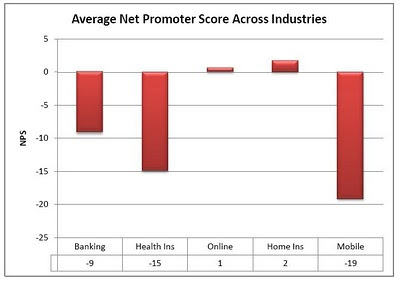
The poor performance of the mobile networks replicates the data from Mark Ritson in 2006. (see also).
The Australian telcos can perhaps take some comfort from a comparative study that suggests there is a "cultural bias" in Australia that means we expect better service (but don't tell that to the tourists who usually complain about abysmal service standards in Oz). It does not however absolve them from the comparative performance across industries.
It is disappointing that the only counter-data is a member survey conducted by ACCAN. This survey had a very small response rate (45 respondents) and the nature of the questions allowed the answers to revolve around things like "overseas call centres".
To this could be added my own research exercise. This had a slightly higher number of respondents and used a methodology on building on a description of a "quality service provider" already developed by the Consumer Council of ACIF. That research identified that the important areas to consumers in which performance was worst were;
* The service provider is proactive in managing quality, and prompt to repair faults.
* The service provider delivers when and what they say they will, with simple instructions on how to use the product.
* The service provider exhibits ‘best practice’ by being open and transparent in its operations, by taking accountability for its actions, its products and services and its commitments and by being credible; acting with integrity.
These may seem amorphous but really are just degrees of being responsive. These can be contrasted with the four high ranking issues in the ACCAN research;
* Multiple transfers to get to the right person to deal with your issue
* The cost of contacting customer service (e.g. when calling from a mobile)
* Poor access for people with disabilities
* Outsourcing of contact centres overseas
Ultimately the issues are slightly more complicated, they relate to the way products and services are marketed. The "confusopoly" is now confusing the IT department and the customer service staff.
Finally, I attempted another online survey recently that only had 37 respondents. This asked two questions, how good was the level of customer service in various industries and whether it had improved or declined in the last twelve months. Zero is acceptable/no change, negative is poor/got worse and positive is good/got better.
Industry Service
Level Improved
Airlines 0.31 -0.28
Banks -0.11 -0.03
Health Insurance 0.24 -0.21
PC & Elect Retail 0.11 -0.24
Grocery Retail 0.32 0.22
Telecc SPs -0.68 -0.31
Property insure 0.17 -0.06
That is telco service providers have comparatively the worst standard of customer service and the perception is it is declining.
Ultimately the telco customer service conversation needs to be engaged in better by all.
Notes:
1. Customer satisfaction as a single shot number is a poor measure because it really maps the gap between expectation and performance. Consumer expectation is learnt, and hence declines as performance declines. As a consequence customer satisfaction tends to trend around 70%. The NPS asks people are more direct question of whether they would recommend their provider and measures the promoters (9 and 10) minus the detractors (1 to 6 (r is it 5)). The other alternative to get meaning into customer service scores is to measure them across industries or to ask whether it has improved or not.
2. Unfortunately this was another case of AAPT changing strategies mid-stream. Before hyperbaric had finished it morphed from being all about the brand promise and tried to be about cost saving. This was despite the project having some serious project management around t. Unsurprisingly when you change the objective mid-project you achieve neither the old or the new objective.
There has been a healthy response from members of the public and consumer representatives. But frankly the response from industry falls short of what we had expected, given the early positive signals from industry chief executives.
Too many of the submissions were little more than reiterations of the current self-regulatory framework and cautioned against any regulatory intervention. I was surprised the telcos did not come up with more constructive solutions to issues they admit are major problems.
I look forward to the industry stepping up with positive proposals to remedy the problems.
I personally find this quite depressing because industry did seem to be initially grappling with the issues. (The submissions don't actually seem to be there to download right now).
However, it can in part be that this is a reaction by industry to the direction of everyone else. The only consumer submission I have seen thus far is that from ACCAN which seems to equally only parrot a decade's worth of comments and rests on a conclusion of the need for more direct regulation.
My own view is somewhat nuanced. I've previously written that, while everyone lumps co-regulation and self-regulation together, that in reality we've never actually tried self-regulation. I also have a view that to try self-regulation may involve some "reverse onus of proof" activities and some programs designed to actively facilitate comparison of offers, views I've shared with industry.
The report in the SMH said that Optus "rejects the hypothesis expressed in ACMA's paper that systemic and enduring customer experience issues do exist", while VHA and AAPT "criticised the ombudsman complaint process."
Meanwhile Telstra said "higher expectations from customers had pushed up complaint levels in recent years," and added it "does not believe the current challenges impacting customer service and complaint handling warrant regulatory intervention."
Which is all really interesting, except that telco customer service really does suck. I remember a great line from AAPT when we embarked on the journey that included the re-branding, the Tell It Like It Is campaign and ultimately Hyperbaric (see note below). CEO Jon Stretch crafted the line that "being the least bad in the industry does not mean you are good."
In the CommsAlliance submission they resort to quoting the ACMA derived stats on "customer satisfaction". However, inside the industry they don't use customer satisfaction scores as there is a case that they are not good predictors of commercial success (see second note below). Instead they use a thing called a Net Promoter Score. A study by Engaged Marketing in 2009 compares the NPS for a few service industries - the averages are detailed in the graphic below.

The poor performance of the mobile networks replicates the data from Mark Ritson in 2006. (see also).
The Australian telcos can perhaps take some comfort from a comparative study that suggests there is a "cultural bias" in Australia that means we expect better service (but don't tell that to the tourists who usually complain about abysmal service standards in Oz). It does not however absolve them from the comparative performance across industries.
It is disappointing that the only counter-data is a member survey conducted by ACCAN. This survey had a very small response rate (45 respondents) and the nature of the questions allowed the answers to revolve around things like "overseas call centres".
To this could be added my own research exercise. This had a slightly higher number of respondents and used a methodology on building on a description of a "quality service provider" already developed by the Consumer Council of ACIF. That research identified that the important areas to consumers in which performance was worst were;
* The service provider is proactive in managing quality, and prompt to repair faults.
* The service provider delivers when and what they say they will, with simple instructions on how to use the product.
* The service provider exhibits ‘best practice’ by being open and transparent in its operations, by taking accountability for its actions, its products and services and its commitments and by being credible; acting with integrity.
These may seem amorphous but really are just degrees of being responsive. These can be contrasted with the four high ranking issues in the ACCAN research;
* Multiple transfers to get to the right person to deal with your issue
* The cost of contacting customer service (e.g. when calling from a mobile)
* Poor access for people with disabilities
* Outsourcing of contact centres overseas
Ultimately the issues are slightly more complicated, they relate to the way products and services are marketed. The "confusopoly" is now confusing the IT department and the customer service staff.
Finally, I attempted another online survey recently that only had 37 respondents. This asked two questions, how good was the level of customer service in various industries and whether it had improved or declined in the last twelve months. Zero is acceptable/no change, negative is poor/got worse and positive is good/got better.
Industry Service
Level Improved
Airlines 0.31 -0.28
Banks -0.11 -0.03
Health Insurance 0.24 -0.21
PC & Elect Retail 0.11 -0.24
Grocery Retail 0.32 0.22
Telecc SPs -0.68 -0.31
Property insure 0.17 -0.06
That is telco service providers have comparatively the worst standard of customer service and the perception is it is declining.
Ultimately the telco customer service conversation needs to be engaged in better by all.
Notes:
1. Customer satisfaction as a single shot number is a poor measure because it really maps the gap between expectation and performance. Consumer expectation is learnt, and hence declines as performance declines. As a consequence customer satisfaction tends to trend around 70%. The NPS asks people are more direct question of whether they would recommend their provider and measures the promoters (9 and 10) minus the detractors (1 to 6 (r is it 5)). The other alternative to get meaning into customer service scores is to measure them across industries or to ask whether it has improved or not.
2. Unfortunately this was another case of AAPT changing strategies mid-stream. Before hyperbaric had finished it morphed from being all about the brand promise and tried to be about cost saving. This was despite the project having some serious project management around t. Unsurprisingly when you change the objective mid-project you achieve neither the old or the new objective.
Tuesday, September 21, 2010
The separation of Telstra
Renai le May writing for itWire has reported on Posum’s excellent expose of the cant inherent in calls for a cost benefit analysis of the NBN.
However, his suggestion that the solution to the problem could have been simply found in the separation of Telstra ignores the complexity of that issue. The single biggest difficulty with an externally imposed separation of Telstra was always that the there is no really simple dividing line in the existing business – systems are vertically integrated, the voice switches at the edge of the network are inherently part of the trunk switching, and even the way DSL is offered as a line sharing service differs technically in the way Telstra supplies to itself and others.
At a seminar organized by the Competitive Carriers Coalition and AAPT in 2005 on the need to improve broadband access in Australia it was identified that the time to achieve separation was when a new access network was built, not separating the old network. The staff of Shadow Minister Stephen Conroy were eager listeners.
We also need to remember that the national conversation about the need for a new access network was started by the owner of the copper network, Telstra. They did this in their FTTN proposal to the Howard Government in mid 2005. In their initial proposal the wholesale service was going to be of a lower standard than the one they supplied to themselves. Over the ensuing year it was not regulatory “certainty” they sought so much as simply a higher access price.
The ALP’s NBN Mark 1 plan was always as much about securing the restructuring of the industry as it was about Government funding of the network. It was the ALP’s expectation that an offer of a Government injection of $4.5B to build a new access network that needed to be structurally separate would create sufficient incentive for Telstra to voluntarily do so. The difficulty with this strategy was that it didn’t count on the brinkmanship that the then Telstra Board and Management were prepared to play. As the deadline for bids grew closer Telstra demanded that the separation requirement be removed. How they erred into believing this was at all possible is one of the imponderables of life – I have my own theories but they are only that.
When they put in their short form bid as part of this stand-off Telstra made a fatal error of not meeting technical bidding requirements (despite employing at least three legal firms on the bid, none of them reviewed the final letter), the Government had no alternative but to exclude them.
In the intervening four years since FTTN had been proposed by Telstra the FTTN technology had moved on apace. No one disputes that eventually we will want to take fibre all the way to the home, the question has only been when. (As an aside a major fault with the Henry Ergas CBA is that he never allows for the fact that using alternative technologies only results in the need to defer the FTTN build not can it completely). The expert panel concluded that over an eight year build cycle it was more cost effective to start building FTTN now and not do a two stage build.
This decision then completely changed the relationship between an NBN build and Telstra. No longer was Telstra critical as the copper loop was not part of the build. The deal that NBN Co has done with Telstra does however reduce NBN Co’s biuild cost and de-risks the revenue line, but it did not need the deal more than Telstra did.
Finally can we all remember that in Australia’s metropolitan areas there are many people not able to receive any fixed broadband, either because the copper runs are too long, or because there is fibre or an active line sharing device on the path.
However, his suggestion that the solution to the problem could have been simply found in the separation of Telstra ignores the complexity of that issue. The single biggest difficulty with an externally imposed separation of Telstra was always that the there is no really simple dividing line in the existing business – systems are vertically integrated, the voice switches at the edge of the network are inherently part of the trunk switching, and even the way DSL is offered as a line sharing service differs technically in the way Telstra supplies to itself and others.
At a seminar organized by the Competitive Carriers Coalition and AAPT in 2005 on the need to improve broadband access in Australia it was identified that the time to achieve separation was when a new access network was built, not separating the old network. The staff of Shadow Minister Stephen Conroy were eager listeners.
We also need to remember that the national conversation about the need for a new access network was started by the owner of the copper network, Telstra. They did this in their FTTN proposal to the Howard Government in mid 2005. In their initial proposal the wholesale service was going to be of a lower standard than the one they supplied to themselves. Over the ensuing year it was not regulatory “certainty” they sought so much as simply a higher access price.
The ALP’s NBN Mark 1 plan was always as much about securing the restructuring of the industry as it was about Government funding of the network. It was the ALP’s expectation that an offer of a Government injection of $4.5B to build a new access network that needed to be structurally separate would create sufficient incentive for Telstra to voluntarily do so. The difficulty with this strategy was that it didn’t count on the brinkmanship that the then Telstra Board and Management were prepared to play. As the deadline for bids grew closer Telstra demanded that the separation requirement be removed. How they erred into believing this was at all possible is one of the imponderables of life – I have my own theories but they are only that.
When they put in their short form bid as part of this stand-off Telstra made a fatal error of not meeting technical bidding requirements (despite employing at least three legal firms on the bid, none of them reviewed the final letter), the Government had no alternative but to exclude them.
In the intervening four years since FTTN had been proposed by Telstra the FTTN technology had moved on apace. No one disputes that eventually we will want to take fibre all the way to the home, the question has only been when. (As an aside a major fault with the Henry Ergas CBA is that he never allows for the fact that using alternative technologies only results in the need to defer the FTTN build not can it completely). The expert panel concluded that over an eight year build cycle it was more cost effective to start building FTTN now and not do a two stage build.
This decision then completely changed the relationship between an NBN build and Telstra. No longer was Telstra critical as the copper loop was not part of the build. The deal that NBN Co has done with Telstra does however reduce NBN Co’s biuild cost and de-risks the revenue line, but it did not need the deal more than Telstra did.
Finally can we all remember that in Australia’s metropolitan areas there are many people not able to receive any fixed broadband, either because the copper runs are too long, or because there is fibre or an active line sharing device on the path.
Monday, September 20, 2010
And now to broadband - briefly
Ah, so while I was away the Government became the Government again, largely because the coalition which trumpets itself as the party of the bush because it contains some Nationals couldn't get a broadband policy together.
As I wrote before the election, the coalition were captives of their past in framing their communications policy. It is therefore reassuring to see Chris Pyne referring to the idea that the coalition will refresh their policy approach. Similar comments were made by the actual shadow Malcolm Turnbull as "In a wide-ranging interview with The Age, Mr Turnbull signalled the Coalition would develop a new broadband policy for the next election rather than stick with the approach taken to this year's poll."
hat has not stopped Turnbull already blathering on about the need for a "cost benefit analysis". A very good piece on why a CBA may not be what the commentariat think it is was re-run today. It might obviate my need to do a similar piece.
Possum Comitatus at his Pollytics blog picks up the main points that a CBA is different from a financial analysis or business case, that the timescales used are longer and that the CBA would be meaningless because of the degree of uncertainty. Put it simply we pay politicians to make decisions - if everything could be decided by simple analysis you'd leave it the bureaucrats alone.
There are some bits he leaves out. The first is that if you are using CBA for comparing projects because of a limited capital pool, then you a) need to do the CBA on all projects not just one, and (b) rather than just an NPV on the benefits over costs you should use a benefit-cost ratio. I have never seen either actually done for any public policy of any magnitude. They are usually restricted to relatively small scale projects.
The second is that a CBA is based on a thing called the "compensation principle" - a benefit to me offsets a cost to you if my benefit is bigger than your cost bcause I could notionally "compensate" you for your loss. This is made worse because a dollar gain to a millionaire is regarded as the same "value" as a dollar loss to a pensioner - even though we know the two "value" that dollar differently. In brief CBA is inherently anti-egalitarian - hence the reason why Australia's private CEOs club (mis-labelled the Business Council of Australia) so favours them.
Let me save or later the conversation on whether advancing the regional deployment changes the priority on wireless.
As I wrote before the election, the coalition were captives of their past in framing their communications policy. It is therefore reassuring to see Chris Pyne referring to the idea that the coalition will refresh their policy approach. Similar comments were made by the actual shadow Malcolm Turnbull as "In a wide-ranging interview with The Age, Mr Turnbull signalled the Coalition would develop a new broadband policy for the next election rather than stick with the approach taken to this year's poll."
hat has not stopped Turnbull already blathering on about the need for a "cost benefit analysis". A very good piece on why a CBA may not be what the commentariat think it is was re-run today. It might obviate my need to do a similar piece.
Possum Comitatus at his Pollytics blog picks up the main points that a CBA is different from a financial analysis or business case, that the timescales used are longer and that the CBA would be meaningless because of the degree of uncertainty. Put it simply we pay politicians to make decisions - if everything could be decided by simple analysis you'd leave it the bureaucrats alone.
There are some bits he leaves out. The first is that if you are using CBA for comparing projects because of a limited capital pool, then you a) need to do the CBA on all projects not just one, and (b) rather than just an NPV on the benefits over costs you should use a benefit-cost ratio. I have never seen either actually done for any public policy of any magnitude. They are usually restricted to relatively small scale projects.
The second is that a CBA is based on a thing called the "compensation principle" - a benefit to me offsets a cost to you if my benefit is bigger than your cost bcause I could notionally "compensate" you for your loss. This is made worse because a dollar gain to a millionaire is regarded as the same "value" as a dollar loss to a pensioner - even though we know the two "value" that dollar differently. In brief CBA is inherently anti-egalitarian - hence the reason why Australia's private CEOs club (mis-labelled the Business Council of Australia) so favours them.
Let me save or later the conversation on whether advancing the regional deployment changes the priority on wireless.
A grab-bag of telco stuff
Ahhh what a great day to return to work. Reports emerged today about both the industry and consumer submissions to the ACMA's Reconnecting the Customer inquiry.
The industry submission (which I couldn't find at the Comms Alliance or the AMTA website. UPDATED - available here) is reported to blame "technology-challenged customers for the surge in complaints about phone and internet services." As I argued in my CPRF paper (subsequently printed in the TJA) this predicament is of the telcos making.
There remains a possibility that the current predicament occurs because the marketing departments of telcos are over-estimating the ability of both customers and call centre staff to understand the details of increasingly complex products. This would then compound the difficulties created by language in the conversation between customers and their service providers.
An extension of that hypothesis would be that the industry collectively needs to take action to manage its use of language to better enable customers and providers to converse. The ACCC
has seen fit to take the industry to task over language that might be misleading within the definition of the law. However, well before that threshold the industry’s way of using language (e.g. ‘uncapped’, ‘unlimited’, ‘cap’ and ‘coverage’) can be sufficiently confusing customers so that providers cannot be seen as offering quality.
Meanwhile Jessica Irvine writing in the SMH of her own personal telco experience argues that all would be well if we just got the competition structure right. I agree with her that there is an important issue of market design here, but I don't think it is as simple as structural separation and all competition is good. There are reasons of information asymmetry that mean competition alone does not improve customer service - as customers are limited in their ability to asses service standards. Equally simple price comparison is not sufficient.
Finally we come to the campaign launched today by ACCAN over the price of calls to 1800 and 13/1300 numbers from mobiles. The issue over the higher than fixed calls pricing of these has emerged now because they are not included in the so-called "caps" on mobile plans. With the increased prevalance of 13/1300 and 1800 numbers this is only now becoming an issue.
The matter could have been resolved by the operators providing 13/1300 and 1800 services years ago by invoking the declaration on mobile originated calls - a declaration that applied only to these B party pays type services. The fixed line operators had no incentive to do so because the price of the access would have looked like the price of terminating access. In those days this was about 23c per minute.
As the declaration was not used it has now been revoked so the ACCC has lost its ability to fix the problem. The possible solution might be for the ACMA to provide claritry through the numbering plan about the charging principle - but even then the ACMA is out of step as everyone charges the old local call fee (25c) for fixed 13 calls - not the current price cap figure (22c) nor the more logical rule that they actually be charged the same as an actual local call.
The mobile network price structures are becoming more perverse, with proliferation of free "on-net" calls and strange caps being subsidised by these outrageous 1300 and 1800 charges.
Meanwhile I note that the ACCC has initiated action against Optus for its think bigger and supersonic campaigns. I don't think the action is based on my own criticism of these plans. I do note that my friend Bob Kuhn (the voice of the Queen My Lord is Much Much Better) noted that the supersonic claim was simply dumb - you'd actually like your internet connection to run at the speed of light not the speed of sound! (Let's not confuse "speed" as in metres per second with "speed" as in bits per second again!).
In the same conversation I relayed the story of Stephen Conroy comparing fibre to wireless and saying something to the effect that fibre was faster because it is light. For the record they are both forms of "light" - that is electro-magnetic energy (waves or particles). The "c" of reltivity is the speed of light in a vacuum - it is slower in the air (radio) and even slower in glass (fibre) - the slowing depends on frequency, hence why a prism splits the frequencies of the rainbow.
Now there is heaps more of stuff to read on the NBN and stuff.
Oh - back to the topic of this post. It looks to me like ACCAn's campaign and their "super-complaint" has been timed to accompany their submission on Reconnecting the Customer. They have made their "super complaint" to back the case for "super complaints". I haven't read the detail - but I'm not sure the addition of a specific complaint provision is required to achieve the outcome.
Meanwhile everyone continues to talk at cross purposes. ACCAN specifically wants the Act to de-prioritise "self-regulation" while they really are criticising "co-regulation". As I've argued elsewhere, self-regulation hasn't really been tried. The difficulty I have with the position of the pro-regulation crowd is that it does stiffle the innovative benefits of competition, but I also don't buy the idea that competition alone provides better customer service or that "more information" solves the information problem.
What everyone should be able to agree on is that there is a great deal of customer confusion and there is a great deal of customer dis-satisfaction. If we could spend a few days discussing what we agree on then we might be able to move forward on what the solution is.
The industry submission (which I couldn't find at the Comms Alliance or the AMTA website. UPDATED - available here) is reported to blame "technology-challenged customers for the surge in complaints about phone and internet services." As I argued in my CPRF paper (subsequently printed in the TJA) this predicament is of the telcos making.
There remains a possibility that the current predicament occurs because the marketing departments of telcos are over-estimating the ability of both customers and call centre staff to understand the details of increasingly complex products. This would then compound the difficulties created by language in the conversation between customers and their service providers.
An extension of that hypothesis would be that the industry collectively needs to take action to manage its use of language to better enable customers and providers to converse. The ACCC
has seen fit to take the industry to task over language that might be misleading within the definition of the law. However, well before that threshold the industry’s way of using language (e.g. ‘uncapped’, ‘unlimited’, ‘cap’ and ‘coverage’) can be sufficiently confusing customers so that providers cannot be seen as offering quality.
Meanwhile Jessica Irvine writing in the SMH of her own personal telco experience argues that all would be well if we just got the competition structure right. I agree with her that there is an important issue of market design here, but I don't think it is as simple as structural separation and all competition is good. There are reasons of information asymmetry that mean competition alone does not improve customer service - as customers are limited in their ability to asses service standards. Equally simple price comparison is not sufficient.
Finally we come to the campaign launched today by ACCAN over the price of calls to 1800 and 13/1300 numbers from mobiles. The issue over the higher than fixed calls pricing of these has emerged now because they are not included in the so-called "caps" on mobile plans. With the increased prevalance of 13/1300 and 1800 numbers this is only now becoming an issue.
The matter could have been resolved by the operators providing 13/1300 and 1800 services years ago by invoking the declaration on mobile originated calls - a declaration that applied only to these B party pays type services. The fixed line operators had no incentive to do so because the price of the access would have looked like the price of terminating access. In those days this was about 23c per minute.
As the declaration was not used it has now been revoked so the ACCC has lost its ability to fix the problem. The possible solution might be for the ACMA to provide claritry through the numbering plan about the charging principle - but even then the ACMA is out of step as everyone charges the old local call fee (25c) for fixed 13 calls - not the current price cap figure (22c) nor the more logical rule that they actually be charged the same as an actual local call.
The mobile network price structures are becoming more perverse, with proliferation of free "on-net" calls and strange caps being subsidised by these outrageous 1300 and 1800 charges.
Meanwhile I note that the ACCC has initiated action against Optus for its think bigger and supersonic campaigns. I don't think the action is based on my own criticism of these plans. I do note that my friend Bob Kuhn (the voice of the Queen My Lord is Much Much Better) noted that the supersonic claim was simply dumb - you'd actually like your internet connection to run at the speed of light not the speed of sound! (Let's not confuse "speed" as in metres per second with "speed" as in bits per second again!).
In the same conversation I relayed the story of Stephen Conroy comparing fibre to wireless and saying something to the effect that fibre was faster because it is light. For the record they are both forms of "light" - that is electro-magnetic energy (waves or particles). The "c" of reltivity is the speed of light in a vacuum - it is slower in the air (radio) and even slower in glass (fibre) - the slowing depends on frequency, hence why a prism splits the frequencies of the rainbow.
Now there is heaps more of stuff to read on the NBN and stuff.
Oh - back to the topic of this post. It looks to me like ACCAn's campaign and their "super-complaint" has been timed to accompany their submission on Reconnecting the Customer. They have made their "super complaint" to back the case for "super complaints". I haven't read the detail - but I'm not sure the addition of a specific complaint provision is required to achieve the outcome.
Meanwhile everyone continues to talk at cross purposes. ACCAN specifically wants the Act to de-prioritise "self-regulation" while they really are criticising "co-regulation". As I've argued elsewhere, self-regulation hasn't really been tried. The difficulty I have with the position of the pro-regulation crowd is that it does stiffle the innovative benefits of competition, but I also don't buy the idea that competition alone provides better customer service or that "more information" solves the information problem.
What everyone should be able to agree on is that there is a great deal of customer confusion and there is a great deal of customer dis-satisfaction. If we could spend a few days discussing what we agree on then we might be able to move forward on what the solution is.
Subscribe to:
Posts (Atom)