Having woken up to the fact that "honouring contracts" never meant finishing the NBN FttH build there, Tasmanians are getting a tad upset.
Mr Turnbull is quoted by ABC as blaming the former Government saying
The contractor has basically stopped work for several months. There's nothing we could do to slow down the rollout in Tasmania because it has been dead stopped.
This is technically incorrect because the contractor was still at work in areas not affected by the remediation pause, and has restarted work already.
This is typical Malcolm Turnbull. Rather than directly respond to the fact that he knows he misled Tasmanians he reaches for a distraction with a false claim about current roll-out.
For the record - mid election (17 August) the Examiner ran a story under the headline Turnbull confirms NBN will honour contracts. It included the following line.
"Tasmanian Senator David Bushby also dismissed Ms Collins by saying the Liberals had costed their policy on Labor's full Tasmanian roll-out, confirming it would honour Mr Turnbull's earlier pledge to fulfil all contracts."
Mr Turnbull knew that to be a false statement at the time and did nothing to correct it!
Sunday, October 06, 2013


To regulate or to deregulate - that is the question...
Communications Minister Malcolm Turnbull appeared on ABC's Insiders today. In the midst of semi-predictable gumph about the NBN there was a short exchange about the Government's deregulation agenda. Mr Turnbull said;
Well, we have got an overall policy right across the government of cutting regulation and red tape and both telecommunications and the media, the broadcast media, obviously, are very heavily regulated. What we are undertaking or commencing now is a study of the level of regulation, so the question is what objectives, what is the policy objectives these regulations seek to serve? Is that objective relevant any longer? If it is not, the regulation should go. If it is still relevant, can we achieve the objective more cost effectively?
Well, we have got an overall policy right across the government of cutting regulation and red tape and both telecommunications and the media, the broadcast media, obviously, are very heavily regulated. What we are undertaking or commencing now is a study of the level of regulation, so the question is what objectives, what is the policy objectives these regulations seek to serve? Is that objective relevant any longer? If it is not, the regulation should go. If it is still relevant, can we achieve the objective more cost effectively?
I am very focused on reducing the cost of doing business in my area and all of my ministerial colleagues are doing the same thing in theirs.
His colleague, the Minister for Foreign Affairs Julie Bishop meanwhile was having a good old spray, reported in the Sunday Tele and other News Corp papers by Sam Maiden, about mobile roaming charges. Ms Bishop said:
Since I have been travelling more extensively, I have received some extraordinarily high bills for global roaming, running into the thousands and thousands of dollars. [The regulator should] have the power to carry out a market investigation but also to
determine what was a reasonable price. In
Australia I understand that we actually need to enhance the ACCC's powers. I
will be talking to Malcolm Turnbull about this.
Ms Bishop was apparently aware of the moves already taken by the ACMA - at the direction of the former Government - to insist travellers are informed of the cost. Despite this Ms Bishop seems to still have been shocked by her bill.
Ms Bishop praised the approach of New Zealand and suggested they had seen good results from a threat to regulate. She might like to note that the "threat" was made bilaterally by PMs Gillard and Kay in February 2013.
She might also note that the Gillard Government proposed to bring this legislation forward in the Winter sitting period, appearing on the list as
Reason for legislation: to implement coordinated action with New Zealand on measures to address the prices to consumers of trans-Tasman mobile roaming
Ms Bishop praised the approach of New Zealand and suggested they had seen good results from a threat to regulate. She might like to note that the "threat" was made bilaterally by PMs Gillard and Kay in February 2013.
She might also note that the Gillard Government proposed to bring this legislation forward in the Winter sitting period, appearing on the list as
Telecommunications (International Mobile
Roaming) Bill
-
amend
telecommunications legislation to clarify that international mobile roaming
services are services that can be regulated where reciprocal arrangements apply
with another countryReason for legislation: to implement coordinated action with New Zealand on measures to address the prices to consumers of trans-Tasman mobile roaming
By recollection the Bill wasn't introduced in June, but it should be already prepared.
So the challenge for Mr Turnbull is whether he dusts off the Bill and introduces it in the first sitting week of the new Parliament - or whether he decides that is not a good look with the overall deregulatory flavour.
Note: the case is a fascinating one in regulation theory, because the market position with high roaming charges is stable...there is no simple way for competition to solve the problem.
So the challenge for Mr Turnbull is whether he dusts off the Bill and introduces it in the first sitting week of the new Parliament - or whether he decides that is not a good look with the overall deregulatory flavour.
Note: the case is a fascinating one in regulation theory, because the market position with high roaming charges is stable...there is no simple way for competition to solve the problem.
Friday, October 04, 2013
Proof that Paul Howes is as thick as be seems.
At last there is proof that Paul Howes is as thick as he seems. Having had his Parliamentary ambition recently thwarted he has signed up to write monthly essays for the AFR to demonstrate his credentials as a leader of extra-parliamentary Labor.
He has made the amazing discovery that investing in infrastructure builds the nation from which the opportunity to make life better for all can come. Pity he didn't notice that investing in infrastructure is what Labor in Government did. Pity he didn't notice that at the first leadership debate Anthony Albanese said he'd be a PM who invested in infrastructure. But I think Howes is part of the right backing for Bill Shorten.
But when he makes claims that a worker might like an infrastructure investment that HALVES a commute time over a wage increase, it is clear he has no idea what you would need to do to halve most commuting times. Take mine to the city - 15 minute walk to station, 45 minute train ride, 15 minute walk from station to office. You can't even make the train trip happen in half the time.
Then he talks about wanting to tap into super savings to fund infrastructure, which then has to be privatised so the super fund can get a return. Well hand off my super! Issue infrastructure bonds a proposed by Hockey and backed by McKibbin and let my fund invest, fine. But don't try to create investments with market rate returns.
But the whole point of super is to take future liability for pensions to of government by creating private savings. If those private savings just get used by government now as a trade for a new future government liability the whole thing becomes absurd.
If this man is a Director of AustralianSuper maybe the Coalition is right to be concerned about union officials on industry super fund Boards.
Novae Meridianae Demetae Dexter delenda est
He has made the amazing discovery that investing in infrastructure builds the nation from which the opportunity to make life better for all can come. Pity he didn't notice that investing in infrastructure is what Labor in Government did. Pity he didn't notice that at the first leadership debate Anthony Albanese said he'd be a PM who invested in infrastructure. But I think Howes is part of the right backing for Bill Shorten.
But when he makes claims that a worker might like an infrastructure investment that HALVES a commute time over a wage increase, it is clear he has no idea what you would need to do to halve most commuting times. Take mine to the city - 15 minute walk to station, 45 minute train ride, 15 minute walk from station to office. You can't even make the train trip happen in half the time.
Then he talks about wanting to tap into super savings to fund infrastructure, which then has to be privatised so the super fund can get a return. Well hand off my super! Issue infrastructure bonds a proposed by Hockey and backed by McKibbin and let my fund invest, fine. But don't try to create investments with market rate returns.
But the whole point of super is to take future liability for pensions to of government by creating private savings. If those private savings just get used by government now as a trade for a new future government liability the whole thing becomes absurd.
If this man is a Director of AustralianSuper maybe the Coalition is right to be concerned about union officials on industry super fund Boards.
Novae Meridianae Demetae Dexter delenda est
Monday, September 30, 2013
Chris Pyne - the gift that keeps giving
Chris Pyne has followed up his comments about Uni places and fees by talking about curricula and testing.
In a memorable line he says ''I don't believe in handing over responsibility for government policy to third parties." And hence asserts his right to recast the National Syllabus.
It does, however, slightly affect his claim that the existing syllabus is Labor oriented - since he clearly acknowledges it was written by a third party and NOT the previous Minister.
He also said, ''I know that the left will find that rather galling and, while we govern for everyone, there is a new management in town.'' Which raises the somewhat frightening concept that every time the Government changes the curriculum should too.
The actual curriculum for years 1-10 only cover Maths, Science, English, History and Geography. The curriculum for senior secondary school are for the same subject areas but in greater depth.
But it was the following excerpt from the report that I thought required more digging.
Mr Pyne said the national history curriculum played down ''the non-Labor side of our history'' despite the Coalition governing for two-thirds of the past 60 years.
I thought I'd look at the content of the Year 1 to 10 Syllabus to try to figure this out, looking at the High School Years. Really Australian history only features in Years 9 and 10 (Year 7 is ancient world, and year 8 is medieval). The last 60 years is exclusively Year 10.
Let's just face a few facts. The big events that can't be avoided are WWI, Depression and WWII. The facts are that Labor governed for most of these periods.
Further examination shows that outside these the focus is on things like cultural change, the war in Indo-China and its aftermath (including refugees) and the environmental movement.
But if we understand that history isn't just content for the sake of content, it isn't just learning a list of Prime Ministers, it ultimately is a study of change. That is it will always look like it is focussed on "progressive politics" because that is where the focus of change rests.
Conservative values are an important part of understanding all these progressive causes. They explain why the causes weren't initially - or in some cases ever - adopted.
If Pyne wants to make sure students read these he should sponsor a set of monographs on the conservative responses to those issues. In the end all change has developed through a dialectic - the existing thesis, a proposed antithesis which resolve to a synthesis. Good history will understand that, but the content areas stay the same.
But I must admit I was wondering what other curricula he thought should be adjusted, because the existing lot is all too much biased by progressives. So, a few thoughts.
In English - lets stick to the classics written before 1900. If we do have to do with modern things like understanding newspapers anything will do so long as it is from News Corp.
In biology - obviously he should throw in intelligent design because this Darwinian evolution stuff is just a dangerous progressive theory.
In physics - clearly Aristotelean physics hasn't really been disproved yet, and if we can teach Newtonian and quantum mechanics then surely the "classical" mechanics can be taught.
In mathematics - complex numbers are right out, how can we possibly have maths based on an imaginary number i?
Finally we come to geography - and in high school geography you learn about weather and climate. True to conservative values this will be taught to be unchanging, just as there will be no discussion of erosion because that is another dangerous progressive idea that the world isn't the same today as it has always been.
Ahh - the wonders of being a conservative! Life is so much simpler - much less to learn and think about.
In a memorable line he says ''I don't believe in handing over responsibility for government policy to third parties." And hence asserts his right to recast the National Syllabus.
It does, however, slightly affect his claim that the existing syllabus is Labor oriented - since he clearly acknowledges it was written by a third party and NOT the previous Minister.
He also said, ''I know that the left will find that rather galling and, while we govern for everyone, there is a new management in town.'' Which raises the somewhat frightening concept that every time the Government changes the curriculum should too.
The actual curriculum for years 1-10 only cover Maths, Science, English, History and Geography. The curriculum for senior secondary school are for the same subject areas but in greater depth.
But it was the following excerpt from the report that I thought required more digging.
Mr Pyne said the national history curriculum played down ''the non-Labor side of our history'' despite the Coalition governing for two-thirds of the past 60 years.
I thought I'd look at the content of the Year 1 to 10 Syllabus to try to figure this out, looking at the High School Years. Really Australian history only features in Years 9 and 10 (Year 7 is ancient world, and year 8 is medieval). The last 60 years is exclusively Year 10.
Let's just face a few facts. The big events that can't be avoided are WWI, Depression and WWII. The facts are that Labor governed for most of these periods.
Further examination shows that outside these the focus is on things like cultural change, the war in Indo-China and its aftermath (including refugees) and the environmental movement.
But if we understand that history isn't just content for the sake of content, it isn't just learning a list of Prime Ministers, it ultimately is a study of change. That is it will always look like it is focussed on "progressive politics" because that is where the focus of change rests.
Conservative values are an important part of understanding all these progressive causes. They explain why the causes weren't initially - or in some cases ever - adopted.
If Pyne wants to make sure students read these he should sponsor a set of monographs on the conservative responses to those issues. In the end all change has developed through a dialectic - the existing thesis, a proposed antithesis which resolve to a synthesis. Good history will understand that, but the content areas stay the same.
But I must admit I was wondering what other curricula he thought should be adjusted, because the existing lot is all too much biased by progressives. So, a few thoughts.
In English - lets stick to the classics written before 1900. If we do have to do with modern things like understanding newspapers anything will do so long as it is from News Corp.
In biology - obviously he should throw in intelligent design because this Darwinian evolution stuff is just a dangerous progressive theory.
In physics - clearly Aristotelean physics hasn't really been disproved yet, and if we can teach Newtonian and quantum mechanics then surely the "classical" mechanics can be taught.
In mathematics - complex numbers are right out, how can we possibly have maths based on an imaginary number i?
Finally we come to geography - and in high school geography you learn about weather and climate. True to conservative values this will be taught to be unchanging, just as there will be no discussion of erosion because that is another dangerous progressive idea that the world isn't the same today as it has always been.
Ahh - the wonders of being a conservative! Life is so much simpler - much less to learn and think about.
Thursday, September 26, 2013
Student Politics
With Chris Pyne saying he wants to abolish the student activities levy we've had lots of commentary as if this is a repeat of compulsory versus voluntary student "unionism".
Some young Liberal bright spark looked down a camera lens and said that student politics was the "training ground" for Labor politicians (as if that alone was a justifiable reason for not having it).
He perhaps needs to know more about his own party to learn
PM Tony Abbott - President SU SRC 1979
Treasurer Joe Hockey - President SU SRC 1987
Communications Minister Malcolm Turnbull - Board Member University of Sydney Union
and going back a bit further
Robert Menzies - President of the Melbourne University SRC 1916
Student politics is a good training ground for lots of people who are later engaged in civic life - including politicians, judges, journalists and others.
Some young Liberal bright spark looked down a camera lens and said that student politics was the "training ground" for Labor politicians (as if that alone was a justifiable reason for not having it).
He perhaps needs to know more about his own party to learn
PM Tony Abbott - President SU SRC 1979
Treasurer Joe Hockey - President SU SRC 1987
Communications Minister Malcolm Turnbull - Board Member University of Sydney Union
and going back a bit further
Robert Menzies - President of the Melbourne University SRC 1916
Student politics is a good training ground for lots of people who are later engaged in civic life - including politicians, judges, journalists and others.
Wednesday, September 25, 2013
Myths of competition
Everyone knows prices are lower with competition - right? Well - actually they aren't. There is absolutely nothing in the theory of competition that says they must be in all circumstances.
But that doesn't stop people from continually asserting it when talking about telecommunications.
The latest horrendous examples occurred on the 7:30 report last night. The short excerpt from a report by Greg Hoy;
IAN MARTIN: Look, I think it's a fantastic opportunity to get more competition going in at least a large part of the market where companies like TPG and Optus will be able to use their own infrastructure to provide services, broadband services, high speed broadband services directly to consumers.
DAVID KENEDY: The Coalition already envisages that it will allow Telstra and Optus, if it wishes, to continue to operate their cable broadband networks which reach about 25 per cent of the Australian market.
GREG HOY: Competition is a good thing, it can drive down prices. But this is sure to trigger a debate as to whether those who haven't already been connected to the NBN will be saddled with an inferior technology for the foreseeable future.
So let's look at the theory and reality of competition.
The assertion that prices are lower under competition comes down to a simple conclusion of orthodox economics. The first conclusion is that a profit maximising firm will set price equal to marginal cost. (see note) The second conclusion is that where the market output is produced by a number of firms (competition) then firms will enter or leave the market till marginal cost equals average cost - so price equals cost and there is no profit. (This is economists profit which includes the need to get a return of and for capital in the cost).
The monopoly scenario is built around a market where there is no entry or exit - and as a consequence the firm's profit maximising position is where the mark-up (that is (price-cost)/price) is equal to the inverse of the own price elasticity of demand.
This also highlights another myth - hat monopolists charge whatever price they want. This is not true. If costs go up or decline then price will too. How much by depends upon the shape of the demand curve and hence how elasticity changes from one point to another (elasticity varies the whole length of a linear demand curve).
If the cost doubles because there are competing firms and even assuming this creates the competitive outcome (see note) for prices to be lower under competition the monopoly mark-up would need to have been over 100%. While that is possible, whether it is in fact the case is an empirical not a theoretical question (that is, what is the actual demand). I am not personally aware of any studies that have indicated this has ever been the mark-up in telecommunications access monopolies.
Which is all good so far. The question is "why one firm?" That can be because of regulatory barriers. But economists recognise it can be because of a thing called "natural monopoly" - which is formally defined as one where the cost function is sub-additive. That is all possible values of industry output can be generated more cheaply by one firm rather than two.
This condition clearly applies to distribution networks. I have said it before - no one who promotes competitive access infrastructure in telecommunications advocates duplicating water pipes, electricity wires or gas pipes.
We have had three types of competition in fixed line telecommunications in Australia. The first between HFC and copper pairs. The second between two HFC networks. The third between competing providers over copper.
The competition between HFC and copper should have been intense because Optus's reason for building HFC was for telephony competition. But it didn't work very well, and the price point for accessing Telstra's copper was cranked down by the ACCC to the point where HFC wasn't really effective - unless used in a bundle. The ability of HFC and copper to co-exist is very similar to the co-existence of gas and electricity. The latter both deliver energy, but the former is better for application that need heat (household heating, cooking, hot water) while the latter is essential for driving everything else. Pay TV was built to deliver linear TV, copper to deliver voice, and both were tweaked to provide two-way data. Both have limitations for data - HFC has poor uploads and shared access capacity, while copper has distance limitations and is severely affected by loop quality.
The issue is that FttH is actually superior to both HFC and copper for all the communications applications. The rationale for competing platforms expires.
The competition between HFC networks was a disaster. The two networks wound up competing on content, and once one got a sustainable lead the market fundamentally tipped. The Optus HFC network still exists but is a poor second cousin to Telstra. It is also important not to get fooled by the accounting treatment of the Optus asset. Over a billion dollars in value has already been written off - an accountant will measure profit against the written off base - for an economist the written off cost never truly goes away.
Finally we had competition on DSL over Telstra copper. Competition cannot be credited with any price declines that came about through the reduction in the ULL price by the ACCC. Where competition has been effective has been in the upstream component - by taking responsibility for the engineering of the service beyond access firms make decisions about Quality of Service. Others gain benefits from scale efficiencies on backhaul (from access to network core) and transit (from core to other places on the internet). Really clever firms understand price elasticity and drop prices in anticipation that lower prices will add scale and reduce average cost to justify the price decline. All of that happens actually in a world just like NBN Co - there is a monopoly access provider.
So really the idea that the access network should be a monopoly is a no-brainer. Costs and prices will be lower.
The question then is why a Government owned one. And there are two simple reasons for that. The first is that as it is a monopoly it needs to be regulated - and one of the best ways of doing that is Government ownership, rather than tension between interests of shareholders and interests of Government. And the second is the ability of Government to be a patient investor, which enables it to make the big call to build the whole network relatively quickly.
Actually the Australian Government has a good record here. The copper telecommunications network was built by Government. When Telecom Australia came to be in 1975 only 62% of households had a phone. The Post Office had been entirely funded through revenues and commonwealth borrowings since at least 1959. When Telecom was created it assumed all $4.5 billion of that debt. Between then and 1989 Telecom paid interest on that debt and repaid $1.5 billion of the principal. When it was corporatized in 1989 the remaining $3 billion was converted to equity. The Government received dividends from Telstra in return. Immediately prior to the first tranche of Telstra being sold it paid a $3 billion "special dividend" to the Government. I can't recall how much the Government got over the three floats - but it was over $50 billion - for an asset with a carrying value of zero!
And an interesting story dredged up from the archives:
Deputy Prime Minister John Anderson says the federal government should consider spending part of the AU$34 billion it will reap from Telstra's sale to build a national fibre-optic network.
Treasurer Peter Costello has said he wants to see all of the money from the Telstra sale tipped into the government's new Future Fund set up to cover public servants' superannuation payouts.
Anderson said a plan by the Nationals think-tank The Page Research Centre, for the government to build an AU$7 billion fibre optic network across Australia, deserved serious investigation.
He also called on the government to have a close look at the true state of Telstra's existing copper wire phone network, its maintenance cost and how much it would cost to replace it if necessary.
Anderson said the issue of how a shortfall of telecommunications services, particularly in the bush, might be met in the future must be addressed.
"It is my view that if it emerges that there are circumstances where the normal commercial forces are not going to drive critical investment in infrastructure and if it becomes apparent that government intervention is needed...the logical first option to fund it would be from the sale proceeds," Anderson told a telecommunications conference in Canberra.
"It's hard not to observe...(that if the technology) was optical fibre rather than copper a lot of the concerns of regional Australians about Internet speed simply would not have arisen."
Later, Anderson told reporters he thought it would be unlikely the government would have to dip into the Telstra sale proceeds to build telecommunications infrastructure.
But he said such a move would be logical if needed.
Note: The orthodox view has been challenged. Steve Keen has demonstrated that the orthodox approach underestimates the actual price in real markets. Also if the market is not fully competitive the mark-up doesn't drop to zero even in theory - the mark-up becomes the HHI divided by elasticity where the HHI (or Herfindahl–Hirschman Index) is the sum of the squares of market shares of firms. The lowest that can be under duopoly is merely half - that is the mark-up is reduced by 50%.
But that doesn't stop people from continually asserting it when talking about telecommunications.
The latest horrendous examples occurred on the 7:30 report last night. The short excerpt from a report by Greg Hoy;
IAN MARTIN: Look, I think it's a fantastic opportunity to get more competition going in at least a large part of the market where companies like TPG and Optus will be able to use their own infrastructure to provide services, broadband services, high speed broadband services directly to consumers.
DAVID KENEDY: The Coalition already envisages that it will allow Telstra and Optus, if it wishes, to continue to operate their cable broadband networks which reach about 25 per cent of the Australian market.
GREG HOY: Competition is a good thing, it can drive down prices. But this is sure to trigger a debate as to whether those who haven't already been connected to the NBN will be saddled with an inferior technology for the foreseeable future.
So let's look at the theory and reality of competition.
The assertion that prices are lower under competition comes down to a simple conclusion of orthodox economics. The first conclusion is that a profit maximising firm will set price equal to marginal cost. (see note) The second conclusion is that where the market output is produced by a number of firms (competition) then firms will enter or leave the market till marginal cost equals average cost - so price equals cost and there is no profit. (This is economists profit which includes the need to get a return of and for capital in the cost).
The monopoly scenario is built around a market where there is no entry or exit - and as a consequence the firm's profit maximising position is where the mark-up (that is (price-cost)/price) is equal to the inverse of the own price elasticity of demand.
This also highlights another myth - hat monopolists charge whatever price they want. This is not true. If costs go up or decline then price will too. How much by depends upon the shape of the demand curve and hence how elasticity changes from one point to another (elasticity varies the whole length of a linear demand curve).
If the cost doubles because there are competing firms and even assuming this creates the competitive outcome (see note) for prices to be lower under competition the monopoly mark-up would need to have been over 100%. While that is possible, whether it is in fact the case is an empirical not a theoretical question (that is, what is the actual demand). I am not personally aware of any studies that have indicated this has ever been the mark-up in telecommunications access monopolies.
Which is all good so far. The question is "why one firm?" That can be because of regulatory barriers. But economists recognise it can be because of a thing called "natural monopoly" - which is formally defined as one where the cost function is sub-additive. That is all possible values of industry output can be generated more cheaply by one firm rather than two.
This condition clearly applies to distribution networks. I have said it before - no one who promotes competitive access infrastructure in telecommunications advocates duplicating water pipes, electricity wires or gas pipes.
We have had three types of competition in fixed line telecommunications in Australia. The first between HFC and copper pairs. The second between two HFC networks. The third between competing providers over copper.
The competition between HFC and copper should have been intense because Optus's reason for building HFC was for telephony competition. But it didn't work very well, and the price point for accessing Telstra's copper was cranked down by the ACCC to the point where HFC wasn't really effective - unless used in a bundle. The ability of HFC and copper to co-exist is very similar to the co-existence of gas and electricity. The latter both deliver energy, but the former is better for application that need heat (household heating, cooking, hot water) while the latter is essential for driving everything else. Pay TV was built to deliver linear TV, copper to deliver voice, and both were tweaked to provide two-way data. Both have limitations for data - HFC has poor uploads and shared access capacity, while copper has distance limitations and is severely affected by loop quality.
The issue is that FttH is actually superior to both HFC and copper for all the communications applications. The rationale for competing platforms expires.
The competition between HFC networks was a disaster. The two networks wound up competing on content, and once one got a sustainable lead the market fundamentally tipped. The Optus HFC network still exists but is a poor second cousin to Telstra. It is also important not to get fooled by the accounting treatment of the Optus asset. Over a billion dollars in value has already been written off - an accountant will measure profit against the written off base - for an economist the written off cost never truly goes away.
Finally we had competition on DSL over Telstra copper. Competition cannot be credited with any price declines that came about through the reduction in the ULL price by the ACCC. Where competition has been effective has been in the upstream component - by taking responsibility for the engineering of the service beyond access firms make decisions about Quality of Service. Others gain benefits from scale efficiencies on backhaul (from access to network core) and transit (from core to other places on the internet). Really clever firms understand price elasticity and drop prices in anticipation that lower prices will add scale and reduce average cost to justify the price decline. All of that happens actually in a world just like NBN Co - there is a monopoly access provider.
So really the idea that the access network should be a monopoly is a no-brainer. Costs and prices will be lower.
The question then is why a Government owned one. And there are two simple reasons for that. The first is that as it is a monopoly it needs to be regulated - and one of the best ways of doing that is Government ownership, rather than tension between interests of shareholders and interests of Government. And the second is the ability of Government to be a patient investor, which enables it to make the big call to build the whole network relatively quickly.
Actually the Australian Government has a good record here. The copper telecommunications network was built by Government. When Telecom Australia came to be in 1975 only 62% of households had a phone. The Post Office had been entirely funded through revenues and commonwealth borrowings since at least 1959. When Telecom was created it assumed all $4.5 billion of that debt. Between then and 1989 Telecom paid interest on that debt and repaid $1.5 billion of the principal. When it was corporatized in 1989 the remaining $3 billion was converted to equity. The Government received dividends from Telstra in return. Immediately prior to the first tranche of Telstra being sold it paid a $3 billion "special dividend" to the Government. I can't recall how much the Government got over the three floats - but it was over $50 billion - for an asset with a carrying value of zero!
And an interesting story dredged up from the archives:
Deputy Prime Minister John Anderson says the federal government should consider spending part of the AU$34 billion it will reap from Telstra's sale to build a national fibre-optic network.
Treasurer Peter Costello has said he wants to see all of the money from the Telstra sale tipped into the government's new Future Fund set up to cover public servants' superannuation payouts.
Anderson said a plan by the Nationals think-tank The Page Research Centre, for the government to build an AU$7 billion fibre optic network across Australia, deserved serious investigation.
He also called on the government to have a close look at the true state of Telstra's existing copper wire phone network, its maintenance cost and how much it would cost to replace it if necessary.
Anderson said the issue of how a shortfall of telecommunications services, particularly in the bush, might be met in the future must be addressed.
"It is my view that if it emerges that there are circumstances where the normal commercial forces are not going to drive critical investment in infrastructure and if it becomes apparent that government intervention is needed...the logical first option to fund it would be from the sale proceeds," Anderson told a telecommunications conference in Canberra.
"It's hard not to observe...(that if the technology) was optical fibre rather than copper a lot of the concerns of regional Australians about Internet speed simply would not have arisen."
Later, Anderson told reporters he thought it would be unlikely the government would have to dip into the Telstra sale proceeds to build telecommunications infrastructure.
But he said such a move would be logical if needed.
Note: The orthodox view has been challenged. Steve Keen has demonstrated that the orthodox approach underestimates the actual price in real markets. Also if the market is not fully competitive the mark-up doesn't drop to zero even in theory - the mark-up becomes the HHI divided by elasticity where the HHI (or Herfindahl–Hirschman Index) is the sum of the squares of market shares of firms. The lowest that can be under duopoly is merely half - that is the mark-up is reduced by 50%.
Monday, September 23, 2013
The Tony Abbott we all really know
Tony Abbott started his political career, like so many others, in student politics.
He shot to fame as the first Right President of the Sydney University SRC for quite sometime, and also through taking the fight up to the extreme left at the Australian Union of Students.
It was his career at Sydney that I knew best. A campaign to become President of the SRC on the key theme that he opposed compulsory student unionism. And his main gripe with compulsory student unionism was that funds went to support minority causes like feminism and gays, and particularly Left causes like Palestine.
But that was the sum total of his policy. He didn't control the whole SRC or even the Executive, so he didn't actually achieve much. The University administration had no interest in voluntary student unionism. They appreciated the services provided and the contribution to campus life from the three funded bodies - the SRC, the Union and the Sports Union.
SRC fees went to many more things than the fringe issues so disliked by Mr Abbott. They funded Honi Soit, an often outrageous newspaper that has still spawned the talents of many Australian writers. They funded many clubs and societies on campus, including faulty societies which brought students together.
The only issue of substance I can recall was a petition Mr Abbott prepared that received enough signatures to require a constitutional amendment for the SRC be put to a vote. The Executive was concerned that the amendments as drafted would make the constitution internally inconsistent and proposed a slightly different amendment be put.
Mr Abbott launched legal action - listed as Abbott v Havyatt et al. The matter never went to hearing as the executive relented. The proposed amendments were put to referendum and defeated.
The purpose of this long tale from over 30 years ago is that the same appears to be Mr Abbott's approach to the much bigger job he won by being clear what he was opposed to, but never what he was in favour of.
Today we read about Mr Abbott's second round (after Climate Change Commission) of agencies to be cut. The common theme is that they are agencies that do things that Mr Abbott just philosophically (note that word) does not support.
So he abolishes the Major Cities Unit in infrastructure, because it will tell him the importance of public transport investment. And Mr Abbott's opposition to public transport investment in entirely illogical since he believes these are "over-manned, union-dominated, government-run train and bus systems''.
He is also unwinding what are tagged "nanny state" agencies. The Australian National Preventative Health Agency - which leads the fight against obesity, alcohol abuse and tobacco use - is listed as one of these. And it performed the sin of spending money researching the effects of a fat tax despite the fact that neither party was proposing one.
And here we come to the first problem of the world according to the Conservatives. They believe the public service exists only to implement policies decided by politicians. They do not want the public service to provide advice on the economic, social and technological changes that might require a policy response.
So where are the politicians in this conservative world meant to get that advice? The first answer is you don't need such advice because the principle approach is to change nothing.
The longer answer, of course, is you get that information from the private sector. The pharmaceutical companies can tell you all you need to know about obesity - can't they? The distillers, brewers and fermenters can tell you all you need to know about the health effects of alcohol, can't they? And didn't the tobacco companies do all the research on tobacco?
And is this really "nanny state" - or is it prudent management of the burgeoning health budget.
Then we get told the Australian Institute of Criminology could be reviewed and possibly merged with a University. Which is possibly fine till you then read about the intention to rip $100 million dollars from Australian Research Council grants.
The Coalition has always run a line of finding some obscure piece of research funding and making out it represents waste. In the article today the example of a costly academic indulgences the Coalition plans to wipe out is "a $443,000 study into the "God of Hegel's Post-Kantian idealism''".
It is quite interesting if you Google that phrase. You find that it is the title of an ARC grant to Professor Paul Redding from the Philosophy Department of the University of Sydney. Professor Redding has edited a volume on "Religion After Kant: God and Culture in the Idealist Era."
Dig further and you realise that Professor Redding's research is part of a bigger Program in the History of Philosophy. I don't really know where we have got to if an ordinary analytic philosophy program is under attack. Maybe we really should stop referring to Abbott's own "philosophy" since his Government has such apparent disregard for it.
Much fun has already been made of this line - "Other key Rudd reforms - including the expensive bid for a seat on the United Nations Security Council - are being wound back with a planned new Australian embassy in Senegal to be abandoned." - in the twitterverse. Memo, we have the seat now. But do we really want to start by reneging on agreements with Africa? Does Julie Bishop have no appreciation that after the Pacific Rim, Australia's next strategic focus is the Indian Ocean Rim?
To add to all this let's just remember how impressive Tony Abbott has always seemed on indigenous affairs - he really does get in touch with his Catholic sense of the need to do "good works" here. But there is now an issue about a plan to spend his first week in office "on country." While it is tempting to suggest the excuse he could use is that it wasn't written down, the more prosaic reality is that the new PM has discovered (a) that there is more to being PM than he thought and (b) that his security detail simply wouldn't countenance it - yet.
But in reality, what you see is the Government that reflects its leader. A leader who knows what he doesn't like - and at the top of the list is any independent research or advice on the policy challenges for the government.
After all, you become Prime Minister or President of the SRC by talking about what you don't like - not what you might actually plan to do.
He shot to fame as the first Right President of the Sydney University SRC for quite sometime, and also through taking the fight up to the extreme left at the Australian Union of Students.
It was his career at Sydney that I knew best. A campaign to become President of the SRC on the key theme that he opposed compulsory student unionism. And his main gripe with compulsory student unionism was that funds went to support minority causes like feminism and gays, and particularly Left causes like Palestine.
But that was the sum total of his policy. He didn't control the whole SRC or even the Executive, so he didn't actually achieve much. The University administration had no interest in voluntary student unionism. They appreciated the services provided and the contribution to campus life from the three funded bodies - the SRC, the Union and the Sports Union.
SRC fees went to many more things than the fringe issues so disliked by Mr Abbott. They funded Honi Soit, an often outrageous newspaper that has still spawned the talents of many Australian writers. They funded many clubs and societies on campus, including faulty societies which brought students together.
The only issue of substance I can recall was a petition Mr Abbott prepared that received enough signatures to require a constitutional amendment for the SRC be put to a vote. The Executive was concerned that the amendments as drafted would make the constitution internally inconsistent and proposed a slightly different amendment be put.
Mr Abbott launched legal action - listed as Abbott v Havyatt et al. The matter never went to hearing as the executive relented. The proposed amendments were put to referendum and defeated.
The purpose of this long tale from over 30 years ago is that the same appears to be Mr Abbott's approach to the much bigger job he won by being clear what he was opposed to, but never what he was in favour of.
Today we read about Mr Abbott's second round (after Climate Change Commission) of agencies to be cut. The common theme is that they are agencies that do things that Mr Abbott just philosophically (note that word) does not support.
So he abolishes the Major Cities Unit in infrastructure, because it will tell him the importance of public transport investment. And Mr Abbott's opposition to public transport investment in entirely illogical since he believes these are "over-manned, union-dominated, government-run train and bus systems''.
He is also unwinding what are tagged "nanny state" agencies. The Australian National Preventative Health Agency - which leads the fight against obesity, alcohol abuse and tobacco use - is listed as one of these. And it performed the sin of spending money researching the effects of a fat tax despite the fact that neither party was proposing one.
And here we come to the first problem of the world according to the Conservatives. They believe the public service exists only to implement policies decided by politicians. They do not want the public service to provide advice on the economic, social and technological changes that might require a policy response.
So where are the politicians in this conservative world meant to get that advice? The first answer is you don't need such advice because the principle approach is to change nothing.
The longer answer, of course, is you get that information from the private sector. The pharmaceutical companies can tell you all you need to know about obesity - can't they? The distillers, brewers and fermenters can tell you all you need to know about the health effects of alcohol, can't they? And didn't the tobacco companies do all the research on tobacco?
And is this really "nanny state" - or is it prudent management of the burgeoning health budget.
Then we get told the Australian Institute of Criminology could be reviewed and possibly merged with a University. Which is possibly fine till you then read about the intention to rip $100 million dollars from Australian Research Council grants.
The Coalition has always run a line of finding some obscure piece of research funding and making out it represents waste. In the article today the example of a costly academic indulgences the Coalition plans to wipe out is "a $443,000 study into the "God of Hegel's Post-Kantian idealism''".
It is quite interesting if you Google that phrase. You find that it is the title of an ARC grant to Professor Paul Redding from the Philosophy Department of the University of Sydney. Professor Redding has edited a volume on "Religion After Kant: God and Culture in the Idealist Era."
Dig further and you realise that Professor Redding's research is part of a bigger Program in the History of Philosophy. I don't really know where we have got to if an ordinary analytic philosophy program is under attack. Maybe we really should stop referring to Abbott's own "philosophy" since his Government has such apparent disregard for it.
Much fun has already been made of this line - "Other key Rudd reforms - including the expensive bid for a seat on the United Nations Security Council - are being wound back with a planned new Australian embassy in Senegal to be abandoned." - in the twitterverse. Memo, we have the seat now. But do we really want to start by reneging on agreements with Africa? Does Julie Bishop have no appreciation that after the Pacific Rim, Australia's next strategic focus is the Indian Ocean Rim?
To add to all this let's just remember how impressive Tony Abbott has always seemed on indigenous affairs - he really does get in touch with his Catholic sense of the need to do "good works" here. But there is now an issue about a plan to spend his first week in office "on country." While it is tempting to suggest the excuse he could use is that it wasn't written down, the more prosaic reality is that the new PM has discovered (a) that there is more to being PM than he thought and (b) that his security detail simply wouldn't countenance it - yet.
But in reality, what you see is the Government that reflects its leader. A leader who knows what he doesn't like - and at the top of the list is any independent research or advice on the policy challenges for the government.
After all, you become Prime Minister or President of the SRC by talking about what you don't like - not what you might actually plan to do.
Wednesday, September 18, 2013
Albo's campaign launch in Sydney
Income inequality
On Monday's QandA David Williamson got away with this statement;
But I think all the naval gazing about the ins and outs of factions and that ignores the fact that the Labor Party has to find a direction to go in, to stand for something and they didn't at this election. I think the obvious thing that they need to stand for is the fact that Australia is becoming one of the more unequal countries in the world in terms of the Gini Index, which measures inequality. They are way out. Australia, US and UK are very unfair societies and Labor is supposed to be standing up for fairness but they run a mile.
This concerned me greatly - especially when Father Bob tweeted it as a fact that Australia was as unequal as the US and UK.
The Wikipedia article on this is very useful because it includes the measurement of the Gini Coefficient from the World Bank, the CIA World Fact Book and the OECD (the first two report as a percentage, the third as a ratio). The OECD reports both before and after taxes and transfers. The closer to 100% (or 1) the more unequal a society is.
Let's just record the values for each of the US, UK and Australia using these four measures in order
US - 45, 45.0 and 0.486, 0.378
UK - 34.0, 40 and 0.456, 0.345
Aust- 30.5, 30.3 and 0.468, 0.336
So on the World Bank and CIA data Australia is much less unequal than the US and UK.
The OECD data is more interesting - before transfers Australia falls between the US and UK, but after transfers is more equal than both (which means our taxes and transfers do a better job of addressing inequality).
Using the OECD data it is correct to say that after transfers Australia is now more unequal than it was in the nineties, and this is cause for concern.
It is also an interesting fact that while before transfers Australia is more equal than France and Germany, that situation reverses after transfers.
On the basis of the data it is wrong to assert that Australia is becoming one of the more unequal countries in the world. It is even wrong to say it of the developed world.
It is fair to say that the trend after transfers has been heading in the direction of more inequality, but one could add that currently by GDP per capita (in $US) Australians are the 5th best well off people on the planet.
But I think all the naval gazing about the ins and outs of factions and that ignores the fact that the Labor Party has to find a direction to go in, to stand for something and they didn't at this election. I think the obvious thing that they need to stand for is the fact that Australia is becoming one of the more unequal countries in the world in terms of the Gini Index, which measures inequality. They are way out. Australia, US and UK are very unfair societies and Labor is supposed to be standing up for fairness but they run a mile.
This concerned me greatly - especially when Father Bob tweeted it as a fact that Australia was as unequal as the US and UK.
The Wikipedia article on this is very useful because it includes the measurement of the Gini Coefficient from the World Bank, the CIA World Fact Book and the OECD (the first two report as a percentage, the third as a ratio). The OECD reports both before and after taxes and transfers. The closer to 100% (or 1) the more unequal a society is.
Let's just record the values for each of the US, UK and Australia using these four measures in order
US - 45, 45.0 and 0.486, 0.378
UK - 34.0, 40 and 0.456, 0.345
Aust- 30.5, 30.3 and 0.468, 0.336
So on the World Bank and CIA data Australia is much less unequal than the US and UK.
The OECD data is more interesting - before transfers Australia falls between the US and UK, but after transfers is more equal than both (which means our taxes and transfers do a better job of addressing inequality).
Using the OECD data it is correct to say that after transfers Australia is now more unequal than it was in the nineties, and this is cause for concern.
It is also an interesting fact that while before transfers Australia is more equal than France and Germany, that situation reverses after transfers.
On the basis of the data it is wrong to assert that Australia is becoming one of the more unequal countries in the world. It is even wrong to say it of the developed world.
It is fair to say that the trend after transfers has been heading in the direction of more inequality, but one could add that currently by GDP per capita (in $US) Australians are the 5th best well off people on the planet.
Robb - again
No sooner had I written about Andrew Robb's claim on Insiders that the mining boom would be rebooted than confirmation came that Robb was moving from Finance to Trade.
Someone at the SMH wrote this comment.
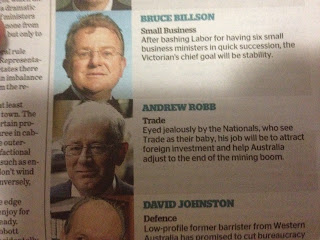
So while Robb has said the mining boom will be rebooted, his job as Trade Minister is to attract foreign investment to help Australia adjust to the end of the mining boom.
Ahhh - if only all politicians could be so "flexible."
Someone at the SMH wrote this comment.

So while Robb has said the mining boom will be rebooted, his job as Trade Minister is to attract foreign investment to help Australia adjust to the end of the mining boom.
Ahhh - if only all politicians could be so "flexible."
Sunday, September 15, 2013
Coalition in disarray on economy
The Coalition's two leading economic Ministers appear to be at odds on what needs to happen in economic management.
The AFR reported this morning (behind paywall) that Joe Hockey has realised the economy continues to need Government expenditure as stimulus. He is therefore planning to bring forward road building to cover the drop off in construction activity as mining softens.
But Finance Minister Andrew Robb told ABC Insiders last Sunday that the mining boom isn't over - it is merely resting due to the mining tax. He said;
As of today the mining boom will be rebooted, right. Under Labor it was finished because of the cost uncompetitiveness that we now have. We will change that. There's $150 billion worth of projects there to be grabbed. We can do so much. We can get Australia open for business. We'll restore an appetite for risk and investment, people's jobs will grow massively. Small business will come out from under the huge shadow that they've had for the last two years.
I tend to agree with Joe.
Mind you if he is really concerned he should make sure the Coalition doesn't change the design of the NBN. It takes a long time to ramp up road projects, but NBN Co is now ready to continue the ramp up of its construction activity.
The AFR reported this morning (behind paywall) that Joe Hockey has realised the economy continues to need Government expenditure as stimulus. He is therefore planning to bring forward road building to cover the drop off in construction activity as mining softens.
But Finance Minister Andrew Robb told ABC Insiders last Sunday that the mining boom isn't over - it is merely resting due to the mining tax. He said;
As of today the mining boom will be rebooted, right. Under Labor it was finished because of the cost uncompetitiveness that we now have. We will change that. There's $150 billion worth of projects there to be grabbed. We can do so much. We can get Australia open for business. We'll restore an appetite for risk and investment, people's jobs will grow massively. Small business will come out from under the huge shadow that they've had for the last two years.
I tend to agree with Joe.
Mind you if he is really concerned he should make sure the Coalition doesn't change the design of the NBN. It takes a long time to ramp up road projects, but NBN Co is now ready to continue the ramp up of its construction activity.
Thursday, September 12, 2013
Economy and Abbott
As an update on yesterday's post The Australian today reported "Economy rides Abbott Victory." The evidence offered was an increase in share price and in consumer confidence.
It is a bit of a worry that this paper equates the economy to the share market. It is about as bad as the way the retailers equate the economy with the sales in their stores.
The reality is the economy is much more than all these.
But the value of shares on the stock market is a measure of expectation, not reality. It is how much people expect the shares to be worth either because of what the companies will earn or (in a bubble) what they will sell for in the future.
If, as noted yesterday, the public has an assumption that the party of the bosses is better at managing the economy, then one would also expect the election of the party of the bosses to create a shift in the stock market. The news that would justify a page one splash would be if this hadn't occurred.
Meanwhile, in commentary on Monday the chair of the BCA was arguing that a double dissolution should be avoided because it would be bad for business and consumer confidence. This follows the business community's comments about the 'minority' government.
One really gets the feeling that the business community and its cheer squad at the Oz just regard democracy as a nasty little impediment to the capitalist state!
Wednesday, September 11, 2013
Better economic managers?
Excellent article by Ross Gittins today.
He makes the point that voters react to the question of who are the better economic managers - Labor or Liberal - instinctively rather than rationally.
He writes in part;
I believe something similar operates in our unconscious attitudes towards the two main political parties. We see the Liberals - the party of the bosses - as the party best suited to run the country.
And that's it - the assumption surely the business people can run the economy better. It matches up with reasons why not all citizens supported replacing autocracy with democracy - surely the lords and kings know better.
In the election Bob Hawke had a stump speech he used at launches and fundraisers where he made the claim for Labor as being the better economic managers - citing the reforms he and Keating made and the way the Rudd Government responded to the GFC.
To that I always add the Whitlam Government for the 25% tariff cut and the Trade Practices Act.
Both parties can screw up on anything. Rational voters would think about what was being said.
There is no way that Abbott-Robb-Hockey are a strong economic management team.
Novae Meridianae Demetae Dexter delenda est
He makes the point that voters react to the question of who are the better economic managers - Labor or Liberal - instinctively rather than rationally.
He writes in part;
I believe something similar operates in our unconscious attitudes towards the two main political parties. We see the Liberals - the party of the bosses - as the party best suited to run the country.
And that's it - the assumption surely the business people can run the economy better. It matches up with reasons why not all citizens supported replacing autocracy with democracy - surely the lords and kings know better.
In the election Bob Hawke had a stump speech he used at launches and fundraisers where he made the claim for Labor as being the better economic managers - citing the reforms he and Keating made and the way the Rudd Government responded to the GFC.
To that I always add the Whitlam Government for the 25% tariff cut and the Trade Practices Act.
Both parties can screw up on anything. Rational voters would think about what was being said.
There is no way that Abbott-Robb-Hockey are a strong economic management team.
Novae Meridianae Demetae Dexter delenda est
Tuesday, September 10, 2013
Ziggy
Just a simple aide memoire for people who might need to write articles about Ziggy Switkowski.
His Wikipedia bio only mentions his Kodak and Optus careers in passing. The CWU division of the CEPU provides a bit more. In particular, that he was chairman and MD of Kodak (Australia) and was credited with the rescue of Kodak. Kodak was almost a basket case but the Labor Federal Government offered incentives.
On 30 April 1996 he was announced as the new CEO of Optus, and resigned just over a year later on 13 June 1997. My recollection - though journalists should check their newspaper archives - was that he fell out with the Board over his inability to develop a strategy.
After eighteen months as GMD of Telstra's Group Managing Director, Business & International Switkowski was appointed CEO of Telstra on 1 March 1999. When his departure was announced in December 2004 the 7:30 Report noted that every time his departure had been rumoured the share price had picked up.
Despite reports - the latest being by Terry McCrann today - that Dr Switkowski has been "tapped" by Malcolom Turnbull to be Executive Chairman of NBN Co, Mr Turnbull has reminded everyone this is a Cabinet appointment.
It would, however, be an extraordinary appointment. Mr Turnbull has repeatedly said the NBN Co Board needs experienced telco people, especially those who can roll out a network.
This just doesn't seem to be a description of John Howard's former nuclear power adviser. His record as a CEO is;
His Wikipedia bio only mentions his Kodak and Optus careers in passing. The CWU division of the CEPU provides a bit more. In particular, that he was chairman and MD of Kodak (Australia) and was credited with the rescue of Kodak. Kodak was almost a basket case but the Labor Federal Government offered incentives.
On 30 April 1996 he was announced as the new CEO of Optus, and resigned just over a year later on 13 June 1997. My recollection - though journalists should check their newspaper archives - was that he fell out with the Board over his inability to develop a strategy.
After eighteen months as GMD of Telstra's Group Managing Director, Business & International Switkowski was appointed CEO of Telstra on 1 March 1999. When his departure was announced in December 2004 the 7:30 Report noted that every time his departure had been rumoured the share price had picked up.
Despite reports - the latest being by Terry McCrann today - that Dr Switkowski has been "tapped" by Malcolom Turnbull to be Executive Chairman of NBN Co, Mr Turnbull has reminded everyone this is a Cabinet appointment.
It would, however, be an extraordinary appointment. Mr Turnbull has repeatedly said the NBN Co Board needs experienced telco people, especially those who can roll out a network.
This just doesn't seem to be a description of John Howard's former nuclear power adviser. His record as a CEO is;
- Turned Kodak around - temporarily - only after a large subsidy from the (Labor) Government.
- Could not deliver a strategy for Opyus.
- Had a disastrous record of $5 billion in acquisitions at Telstra and ended by contemplating - while still majority owned by the Government - buying the Nine Network.
Monday, September 09, 2013
A nice description of the dilemma
There wasn't a lot to distinguish Rudd and Gillard. But this Canberra Times story neatly covers one part of it.
It said in part
The great project, first begun by Gough Whitlam and later rebuilt by Bob Hawke, is threatened as never before. In the long, barren decades of defeat after Labor lost office in 1948, Whitlam's critical insight was the party needed to reach out.
On Saturday, that alliance fell apart. Gillard had defined the fault line by identifying herself with the workers, rather than the progressive elements of the party. That was a desperate attempt to bolster her own internal support. But Kevin Rudd has also proved unable to reach out. Voters decided that he - and Labor - have been unable to present a plausible narrative for Australia's future.
This is a clear distinction. For Gillard the ALP is a labor party, for Rudd the ALP is a progressive party.
But those constituencies don't perfectly overlap. The classic problem area is the battle between development and conservation - a Labor party wants jobs for loggers, a progressive party wants to save the environment.
The distinction spills over into the conceptions for the organisation of the party.
The distinction between Shorten and Albanese is a bit the same, though the evidence suggests each has a more nuanced view.
Novae Meridianae Demetae Dexter delenda est
It said in part
The great project, first begun by Gough Whitlam and later rebuilt by Bob Hawke, is threatened as never before. In the long, barren decades of defeat after Labor lost office in 1948, Whitlam's critical insight was the party needed to reach out.
Advertisement
It could no longer simply rely on the workers' votes. It needed a broader base: cultural workers, environmentalists, and the middle class.On Saturday, that alliance fell apart. Gillard had defined the fault line by identifying herself with the workers, rather than the progressive elements of the party. That was a desperate attempt to bolster her own internal support. But Kevin Rudd has also proved unable to reach out. Voters decided that he - and Labor - have been unable to present a plausible narrative for Australia's future.
This is a clear distinction. For Gillard the ALP is a labor party, for Rudd the ALP is a progressive party.
But those constituencies don't perfectly overlap. The classic problem area is the battle between development and conservation - a Labor party wants jobs for loggers, a progressive party wants to save the environment.
The distinction spills over into the conceptions for the organisation of the party.
The distinction between Shorten and Albanese is a bit the same, though the evidence suggests each has a more nuanced view.
Novae Meridianae Demetae Dexter delenda est
Friday, September 06, 2013
The Dog Ate My Homework
The full glory of the Coalition filter "clusterf__k" is shown here.
http://youtu.be/wgxNvBJsTy4
Still begs the question of how it happened. ZDnet and The Age are reporting that Malcolm Turnbull is effectively blaming party headquarters.
But let's really look at the Coalition spokesman on Broadband, Communications and the Digital Economy. What has he done in three years?
OK - he released a broadband policy - but it doesn't actually have a detailed business plan as he claims. Nothing like it. And it leaves as many questions left unanswered - the cost of the copper, the placement of nodes, the digital divide.
The "digital economy" policy he released really only talked about Government IT. The only comment on real digital economies was to name Sweden, Denmark, Korea and Singapore as leading digital economies - all leaders in deploying fibre to the home.
He has criticised the Government for not completing anti-siphoning legislation - but not said what he will do.
His only comment on ABC and SBS fuinding is that their budgets will be cut if savings need to be made (Labor even exempted them from the efficiency dividend).
Cyber-safety he outsourced to a backbench committee and didn't read their policy.
It isn't an impressive record over three years. Maybe he was just too busy appearing on QandA to do the real job of a shadow minister.
http://youtu.be/wgxNvBJsTy4
Still begs the question of how it happened. ZDnet and The Age are reporting that Malcolm Turnbull is effectively blaming party headquarters.
But let's really look at the Coalition spokesman on Broadband, Communications and the Digital Economy. What has he done in three years?
OK - he released a broadband policy - but it doesn't actually have a detailed business plan as he claims. Nothing like it. And it leaves as many questions left unanswered - the cost of the copper, the placement of nodes, the digital divide.
The "digital economy" policy he released really only talked about Government IT. The only comment on real digital economies was to name Sweden, Denmark, Korea and Singapore as leading digital economies - all leaders in deploying fibre to the home.
He has criticised the Government for not completing anti-siphoning legislation - but not said what he will do.
His only comment on ABC and SBS fuinding is that their budgets will be cut if savings need to be made (Labor even exempted them from the efficiency dividend).
Cyber-safety he outsourced to a backbench committee and didn't read their policy.
It isn't an impressive record over three years. Maybe he was just too busy appearing on QandA to do the real job of a shadow minister.
Coalition NBN fantasy land
The Coalition's commentary on broadband in this election campaign has been one giant fantasy land.
They have a lso made the following false claims about their own policy.
Claim: That the Coalition policy contained a detailed business plan.[12]
It has been led by the following
false claims about Labor’s policy:
Claim: Labor’s NBN will cost taxpayers upwards of a $100 billion.[1]
Fact: Government equity for Labor’s NBN is $30.4 billion. This is an investment that will generate a 7%
return.[2]
The Coalition plans to invest just 3% less for a network that can only
guarantee one fourtieth the speed.
A full analysis of how the Coalition concocted this number and why it is wrong can be found here.
Claim: Labor’s NBN is going to result in a dramatic increase in broadband
prices.[3]
Fact: Broadband plans available on the NBN are already available at
comparable prices to existing plans for a better service. Wholesale prices will
decrease in real and nominal terms. Average Revenue Per User will grow as
consumers choose higher speed plans and use more data, but will not increase as
a percentage of household wallets.
Claim: That if NBN Co was a listed company and hadn’t released its Corporate
Plan the ASX would suspend it.
Fact: There is no requirement for companies to publish their corporate plan,
there isn’t even a requirement for Government Business Enterprises to publish
their Corporate Plans. The release of the annual Corporate Plan of NBN Co is
part of the unprecedented level of transparency on this project.
Claim: That NBN Co claim
to have passed premises which they cannot connect.[4]
Fact: As NBN Co states the
premises referred to can connect but require different processes. Specifically
that includes the need to agree with a Body Corporate on the way to cable the
specific building.
Claim: The Coalition will acquire ownership of the last mile copper, for no
additional payment.[5]
Fact: In May 2011 Mr Turnbull berated the Government’s deal with Telstra
saying “the inability of future governments to make use of parts of the copper
network was a disastrous oversight that could potentially deliver billions of
additional dollars to Telstra at the expense of taxpayers.”[6]
Telstra has not backed this assertion.
Claim: That the Coalition
has built the cost of remediating copper and quite a bit of contingency into
determining a $900 cost per premise for fibre to the node.[7]
Fact: Mr Turnbull invented
a $3600 cost per premise for fibre to the premise and then claimed that on the
basis of overseas examples his fibre to the node would cost 25% of that. There
is no analysis of actual costs and not even a specification of how many nodes
and what the actual fibre lop lengths will be.
Claim: All contracts will be honoured.[8]
Fact: The Coalition policy
says “The Coalition reserves the right to review and seek to vary any of those
contracts in the light of the Coalition’s broadband policy.”[9] There are 200,000 premises already passed and
a further 1 million for which contractors are already at work; but Mr
Turnbull’s policy only provides for completing 565,000 premises under Labor’s
structure.[10] This is
not consistent with the claim that contracts will be honoured.
Claim: More people will
get fixed line broadband, and at higher speeds and less cost under the
Coalition policy.[11]
Fact: The Coalition policy
specifies that the same approach to fixed wireless and satellite will be taken
as Labor. There is no difference in the
forecast premises to be addressed by fixed lines in either policy.
Fact: The Coalition policy document contained two pages of data on how their policy was costed - most of which didn't reconcile with other statements. For example, ARPU grew at 9% not the 6% claimed. The CapEx and OpEx numbers were only provided to 2019 and did not reconcile with totals claimed to 2021.
[1] Sky News
23 August 2013
[2] NBN Co
Corporate Plan 2012-15, and reconfirmed at Joint Committee on the NBN 19 April
2013
[3] Sky News
23 August 2013
[4] Malcolm
Turnbull interviewed by Alan Jones 28 August 2013
[5] Sky News
23 August 2013
[7] Malcolm
Turnbull interviewed by Tom Tilley on Triple-Js’ Hack 22 August 2013
[8] Malcolm
Turnbull interviewed by Tom Tilley on Triple-Js’ Hack 22 August 2013
[9]
Coalition policy page 12.
[10]
Coalition policy – background paper Page 31.
[11] Malcolm
Turnbull interviewed on ABC South East NSW Mornings 5 August 2013
[12] Malcolm Turnbull interviewed by Tom Tilley on Triple-Js’ Hack 5 September2013
[12] Malcolm Turnbull interviewed by Tom Tilley on Triple-Js’ Hack 5 September2013
Thursday, September 05, 2013
When is free speech not free speech?
In the last policy to be announced for the election - less than 40 hours from polling - the Coalition propose a new restriction on what people can say on-line.
It seems like these fine gentlemen propose an e-Safety Commissioner to be charged with the power to direct that content be taken down from social media websites. No court, no process, just a single content censor.
Go figure. Meanwhile their leader wants to roll back Racial Discrimination laws in the name of "free speech"
Mr Abbott said
"Any suggestion you can have free speech as long as it doesn't hurt people's feelings is ridiculous. If we are going to be a robust democracy, if we are going to be a strong civil society, if we are going to maintain that great spirit of inquiry, which is the spark that has made our civilisation so strong, then we've got to allow people to say things that are unsayable in polite company."
It seems like these fine gentlemen propose an e-Safety Commissioner to be charged with the power to direct that content be taken down from social media websites. No court, no process, just a single content censor.
Go figure. Meanwhile their leader wants to roll back Racial Discrimination laws in the name of "free speech"
Mr Abbott said
"Any suggestion you can have free speech as long as it doesn't hurt people's feelings is ridiculous. If we are going to be a robust democracy, if we are going to be a strong civil society, if we are going to maintain that great spirit of inquiry, which is the spark that has made our civilisation so strong, then we've got to allow people to say things that are unsayable in polite company."
Thursday, July 04, 2013
It is Wild West Week!
It is currently "Wild West Week" on Masterchef Australia. It seems this has inspired some others from WA to get in on the act.
iiNet regulatory boss Steve Dalby decided it was a good day to tell the management of NBN Co exactly what he thought of them....or at least to tell the AFR's David Ramli.
He is reported to have said;
If they don’t get their shit together, we will just happily go about our business and do our own thing. NBN Co’s attitude is very dictatorial, it’s very public service and it’s very ‘take it or leave it’. It’s just surprising they have this attitude when you can actually leave it.
NBN Co needs us more than we need them and that is not portrayed in any way by their attitude. If nobody signs their [wholesale broadband agreement] and nobody agrees with their SAU and they have no success as a business then they’re f---ed.
He certainly bested former communications minister Stephen Conroy who had only dropped the f-bomb at the National Press Club in December 2011, and a "shit" when he realised he was late for Question Time at a press conference on the media reforms in March 2013. Dalby apparently managed both in the one on the record interview.
Of course, most of this is bluster - the typical stuff of which all negotiations are made. But it is also a bit delusional. NBN Co just needs one service provider to call iiNet's bluff. It will be a very hard "access strike" to pull off. And as the figures on take-up provided to Senate Estimates in May show take-up is faster in the areas being switched on now. Not marketing to these customers doesn't sound like a good idea.
The other question is exactly what iiNet means by "do their own thing". Apart from the access networks they bought with Transact iiNet has never done its own thing - it has used Telstra's copper lines.
There is a rule in the strategy business that if you want to make a threat - make it a credible one.
There were plenty of other ways for iiNet to make its pre-emptive strike about a document to be released by the ACCC that day (and it now has been).
Maybe Steve was just competing with his boss in a "most outrageous claim of the week" competition.
In a piece in the AFR that deserves a blog post all of its own, Malone was said to have called for [new Minister] Mr Albanese to allow NBN Co to run fibre optic cabling to the basement of apartment buildings instead of connecting every single unit – a move the Coalition has already pledged to do if it wins power. “That’s a change they can make literally overnight and it would mean you could commit to putting 15-to-20 per cent of Australians onto the NBN next year,” he apparently said.
Given that NBN Co will complete the rollout to 12 million premises by 2021, and that it is in 2013 at 200,000 it is already planning to do about 12.5% per year.
Some 30% of premises are MDUs, but they are not all in clusters so you still have to do most of the fibre rollout work for the whole area in which the MDU sits. And even if you decide only to roll the fibre to the MDUs, you still need to do the full design work for the whole area in which the MDU sits.
But also the average size of MDUs is eight units. As outlined at the JCNBN the issue is that once you realise that the project savings aren't that great. And if we don't take fibre to the unit now...when do we? The argument of "let them use copper" is a bit like arguing that all the workmen's cottages (now called terrace houses) built in the 19th century should never have been connected to electricity - after all they had gas, and no internal wiring.
Telco policy discussion has never been renowned for consistency or logic of argument. Once upon a time though the journalist involved might have thought to challenge the comment - not merely repeat it because it suited the masthead's editorial line.
(That said - Steve is just as right to push the interests of his company as NBN Co is in acting in the interests of its shareholders (us), Mike is right to suggest the company should always be pushed by the shareholders to get the best outcome, and David is right to want to get column inches under his byline. But unfortunately all of this doesn't result in considered policy analysis.)
iiNet regulatory boss Steve Dalby decided it was a good day to tell the management of NBN Co exactly what he thought of them....or at least to tell the AFR's David Ramli.
He is reported to have said;
If they don’t get their shit together, we will just happily go about our business and do our own thing. NBN Co’s attitude is very dictatorial, it’s very public service and it’s very ‘take it or leave it’. It’s just surprising they have this attitude when you can actually leave it.
NBN Co needs us more than we need them and that is not portrayed in any way by their attitude. If nobody signs their [wholesale broadband agreement] and nobody agrees with their SAU and they have no success as a business then they’re f---ed.
He certainly bested former communications minister Stephen Conroy who had only dropped the f-bomb at the National Press Club in December 2011, and a "shit" when he realised he was late for Question Time at a press conference on the media reforms in March 2013. Dalby apparently managed both in the one on the record interview.
Of course, most of this is bluster - the typical stuff of which all negotiations are made. But it is also a bit delusional. NBN Co just needs one service provider to call iiNet's bluff. It will be a very hard "access strike" to pull off. And as the figures on take-up provided to Senate Estimates in May show take-up is faster in the areas being switched on now. Not marketing to these customers doesn't sound like a good idea.
The other question is exactly what iiNet means by "do their own thing". Apart from the access networks they bought with Transact iiNet has never done its own thing - it has used Telstra's copper lines.
There is a rule in the strategy business that if you want to make a threat - make it a credible one.
There were plenty of other ways for iiNet to make its pre-emptive strike about a document to be released by the ACCC that day (and it now has been).
Maybe Steve was just competing with his boss in a "most outrageous claim of the week" competition.
In a piece in the AFR that deserves a blog post all of its own, Malone was said to have called for [new Minister] Mr Albanese to allow NBN Co to run fibre optic cabling to the basement of apartment buildings instead of connecting every single unit – a move the Coalition has already pledged to do if it wins power. “That’s a change they can make literally overnight and it would mean you could commit to putting 15-to-20 per cent of Australians onto the NBN next year,” he apparently said.
Given that NBN Co will complete the rollout to 12 million premises by 2021, and that it is in 2013 at 200,000 it is already planning to do about 12.5% per year.
Some 30% of premises are MDUs, but they are not all in clusters so you still have to do most of the fibre rollout work for the whole area in which the MDU sits. And even if you decide only to roll the fibre to the MDUs, you still need to do the full design work for the whole area in which the MDU sits.
But also the average size of MDUs is eight units. As outlined at the JCNBN the issue is that once you realise that the project savings aren't that great. And if we don't take fibre to the unit now...when do we? The argument of "let them use copper" is a bit like arguing that all the workmen's cottages (now called terrace houses) built in the 19th century should never have been connected to electricity - after all they had gas, and no internal wiring.
Telco policy discussion has never been renowned for consistency or logic of argument. Once upon a time though the journalist involved might have thought to challenge the comment - not merely repeat it because it suited the masthead's editorial line.
(That said - Steve is just as right to push the interests of his company as NBN Co is in acting in the interests of its shareholders (us), Mike is right to suggest the company should always be pushed by the shareholders to get the best outcome, and David is right to want to get column inches under his byline. But unfortunately all of this doesn't result in considered policy analysis.)
Tuesday, July 02, 2013
Telcos and trust
It has been an interesting time in telco land recently. It is impossible not to notice that telcos are rediscovering consumer trust as an important lever in delivering financial results.
One can see this in the extent to which customer service features in recent presentations. Improving customer satisfaction was the first of the four strategies listed by Telstra in its Investor Day presentation in October.
Optus' Kevin Russell titled his recent AICC adress Transforming Customer Experience. In that speech he said " Standards of service in Australia relative to standards of service that I'd seen change in the UK, just seem to, in my view, have gone backwards."
Optus also released research on Customer Service: Perceptions & Expectations. The research showed negative advocacy scores for the telco sector - that is assumed to be a measure similar to the Net Promoter Score.
Vodafone's Bill Morrow was more direct in comments reported by The Australian. He said "2013 is all about trying to earn back trust.." He added "Mr Morrow's presentation outlined a journey for Vodafone from "low trust" in 2011 to "most trusted" by the end of the year."
All these comments came to mind when today I read an item from the UK about Sainsbury becoming an MVNO. In part the report read:
Called Mobile by Sainsbury's, the service is due to launch this summer and aims to remove what it claims is the stress of choosing a suitable mobile tariff.
"Our customers trust us to provide top quality products and service at fair prices, and Mobile by Sainsbury's feels like a natural extension of our brand as well as a great way to reward our customers," said Luke Jensen, group development director at Sainsbury's, in a statement.
There is that word "trust" again.
Students of marketing, and more specifically the real science of markets that is economics, know how important brand and trust are in the context of markets with assymetric information.
The strategy in the Sainsbury case is to try to take the brand value from retail to mobile, in a belief that the brand value can withstand the negative effect of the telcos.
The practical reality seems to be from telcos however that the negative effect of the mobile ecosystem will damage any brand.
There is an alternative route for telcos which is to reduce the extent of the information assymetry.
(Technically I think there are three responses to the market for lemons. The first is to remove the information assymetry. The second is to provide a warranty against the negative outcomes. The third is building trust as a supplier. Clearly both the first two can be used as part of building the third.)
One of the most important questions is whether this problem really can be solved by each telco alone or whether there is an over-arching issue that requires co-operation. I touched on this in a TJA article in 2010. I also addressed the issue of why competition doesn't necessarily result in improved customer service in a submission to the ACMA.
The signs are there that the three mobile network owners in Australia understand the dimension of the problem. If they think the value in the response is only in a battle for market share then there will be no co-operative action. But if they recognise that the outcome can be increasing the perceived value of their product there might be a different approach.
One can see this in the extent to which customer service features in recent presentations. Improving customer satisfaction was the first of the four strategies listed by Telstra in its Investor Day presentation in October.
Optus' Kevin Russell titled his recent AICC adress Transforming Customer Experience. In that speech he said " Standards of service in Australia relative to standards of service that I'd seen change in the UK, just seem to, in my view, have gone backwards."
Optus also released research on Customer Service: Perceptions & Expectations. The research showed negative advocacy scores for the telco sector - that is assumed to be a measure similar to the Net Promoter Score.
Vodafone's Bill Morrow was more direct in comments reported by The Australian. He said "2013 is all about trying to earn back trust.." He added "Mr Morrow's presentation outlined a journey for Vodafone from "low trust" in 2011 to "most trusted" by the end of the year."
All these comments came to mind when today I read an item from the UK about Sainsbury becoming an MVNO. In part the report read:
Called Mobile by Sainsbury's, the service is due to launch this summer and aims to remove what it claims is the stress of choosing a suitable mobile tariff.
"Our customers trust us to provide top quality products and service at fair prices, and Mobile by Sainsbury's feels like a natural extension of our brand as well as a great way to reward our customers," said Luke Jensen, group development director at Sainsbury's, in a statement.
There is that word "trust" again.
Students of marketing, and more specifically the real science of markets that is economics, know how important brand and trust are in the context of markets with assymetric information.
The strategy in the Sainsbury case is to try to take the brand value from retail to mobile, in a belief that the brand value can withstand the negative effect of the telcos.
The practical reality seems to be from telcos however that the negative effect of the mobile ecosystem will damage any brand.
There is an alternative route for telcos which is to reduce the extent of the information assymetry.
(Technically I think there are three responses to the market for lemons. The first is to remove the information assymetry. The second is to provide a warranty against the negative outcomes. The third is building trust as a supplier. Clearly both the first two can be used as part of building the third.)
One of the most important questions is whether this problem really can be solved by each telco alone or whether there is an over-arching issue that requires co-operation. I touched on this in a TJA article in 2010. I also addressed the issue of why competition doesn't necessarily result in improved customer service in a submission to the ACMA.
The signs are there that the three mobile network owners in Australia understand the dimension of the problem. If they think the value in the response is only in a battle for market share then there will be no co-operative action. But if they recognise that the outcome can be increasing the perceived value of their product there might be a different approach.
Subscribe to:
Posts (Atom)